
<流れ>
①かっこを振っていない英文
②単語注(①でアスタリスクを振ったところ)
③設問
④かっこを振った英文
⑤設問の答え
⑥訳
XⅢ. HOW I FELL IN WITH THE CURATE.
第13章 助任司祭との邂逅です!
※fall in with~と偶然出会ってかかわりを持つ
第13章 第1段落 (第217話)
第12章までの『宇宙戦争』

自己紹介ネタも尽きたし、担当国旗・国章紹介、ひとことずつやろっか。
あ、念のため一応言っとくけど、担当国設定は『宇宙戦争』小説中では一切関係ないからな。会話編だけの設定だからな。
ともあれ、まずわたし。運だけは強い社会学者の語り手(GuP西住まほ)だ。


国章は黒鷲だ。神聖ローマ帝国時代は双頭の鷲だったんだが…。
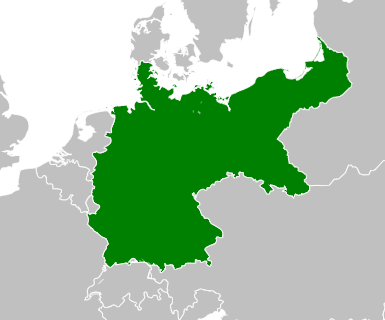
(1871~1918:ドイツ帝国)(↑1914年の領土)

ユニオンフラッグに栄光あれ。語り手の奥さん役のGuPダージリンよ。

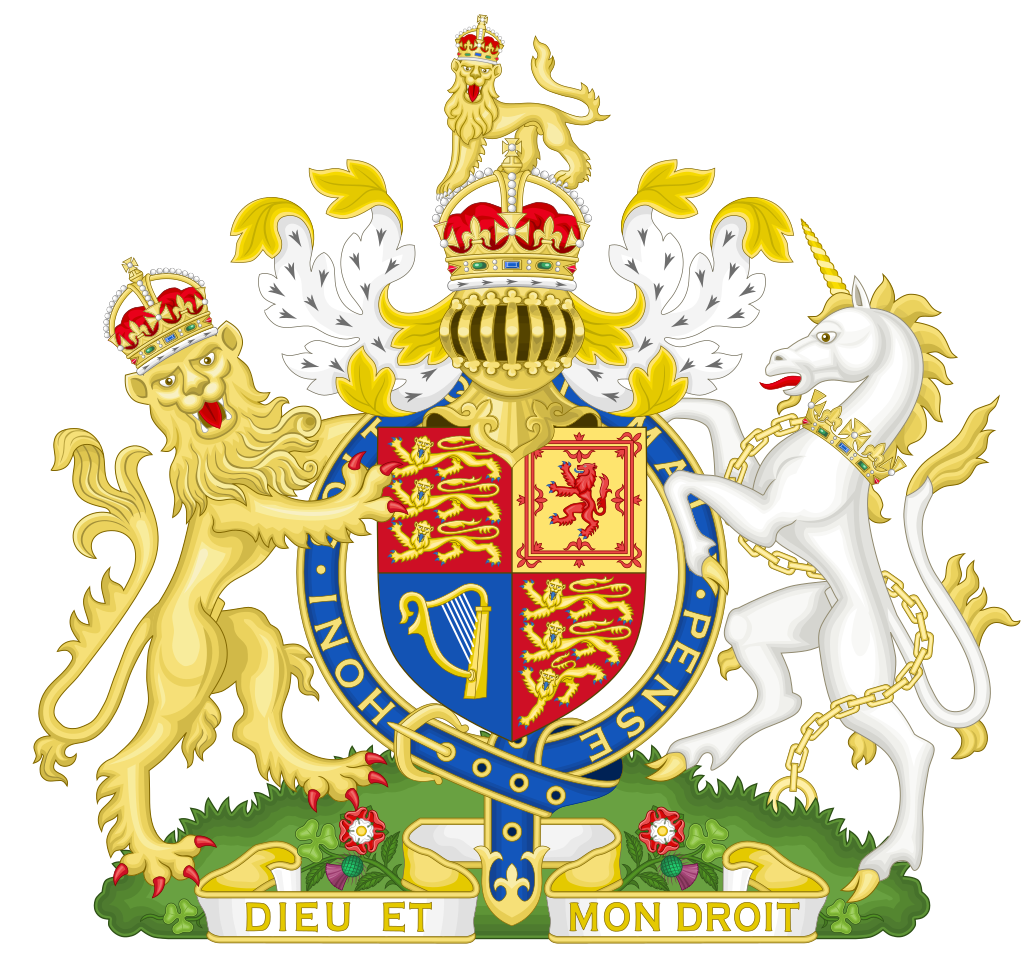
国章にはユニコーンとライオンが書いてあるわ。がおー。
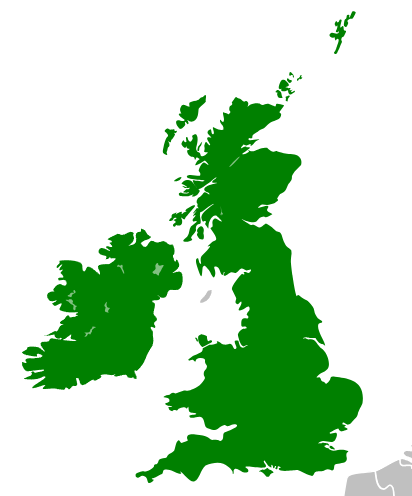
(1801~1922:グレートブリテン及びアイルランド連合王国)

トリコロールの白は王家の色、赤青は帽章由来らしいにゃ。どうもステント(GuPマリー)にゃ。


じつはフランスに公式国章はないにゃ。
(1870~1940:第三共和政)

イタリア国旗はトリコローレって言うんだぜ、とオギルヴィ(GuPアンチョビ)だ。
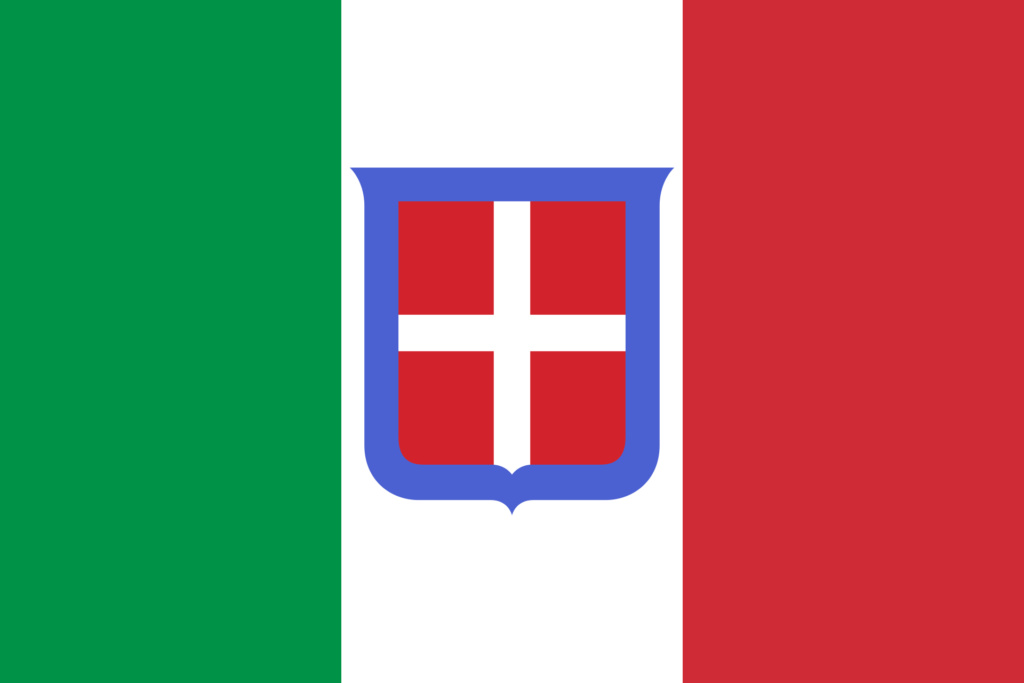
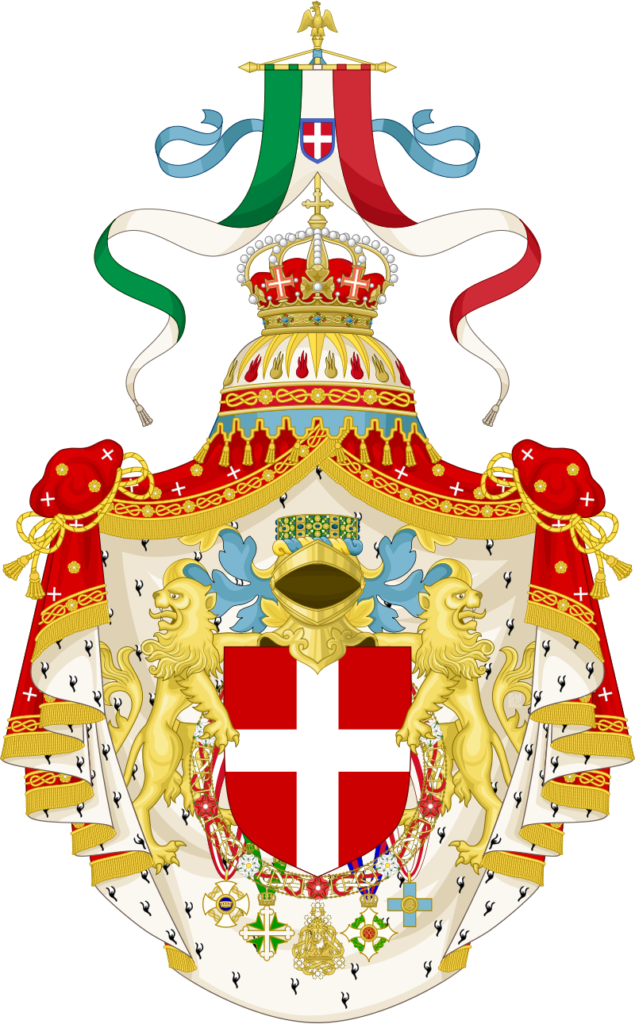
サルデーニャ王国のサヴォイア家の紋章が元となっているぞ。
(1861~1946:イタリア王国)

ハロー、ヘンダーソン(GuPケイ)だよ! Old Glory(星条旗)はいっぱいアップデートしてるよ!


(↑1896~1908:星45個の星条旗)
国章に描かれてるのはハクトウワシだね!

こんにちは!パブの主人役、GuP西絹代です!


大日本帝国時代は、軍旗はあの旭日旗でしたが、外交上はこっちの普通の日の丸です。

やっほー。砲兵役、GuPミカだよー。
フィンランドは(いちおう)これなのだ。

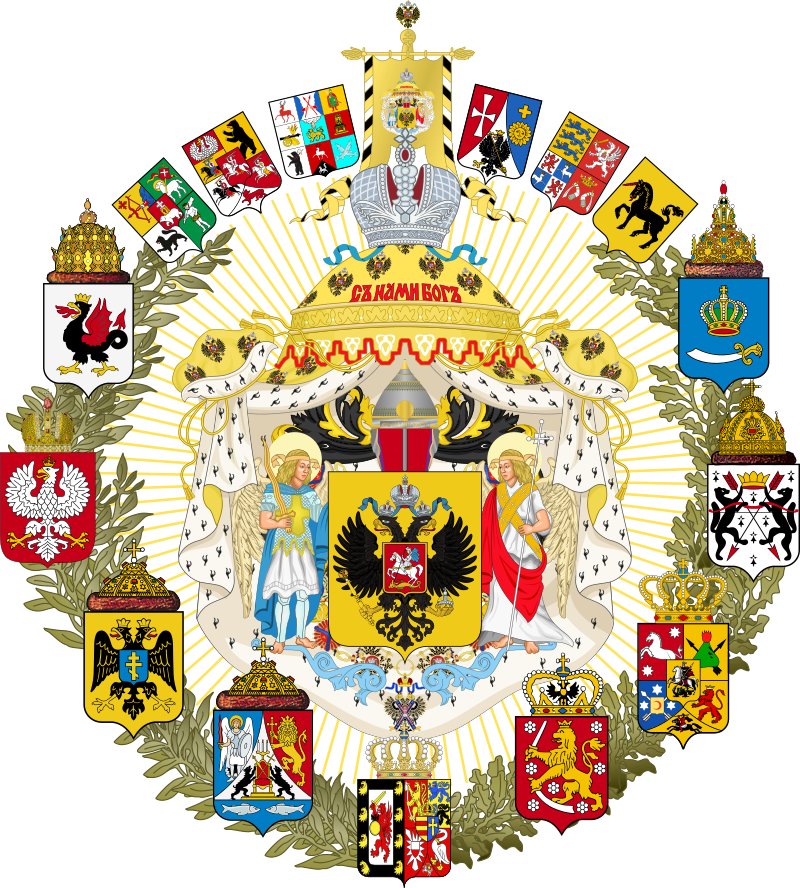
おいまて、それロシア帝国じゃないか。
だって、フィンランドはロシア帝国領だったのだから仕方ないじゃないか(1809~1917)。そのまえはスウェーデン領だったし。

ま、ほぼほぼ独立国みたいなフィンランド大公国だったけどね。
とゆーことで最後に、ちょっと部外者みたいなデナリスです。
それじゃ、かんたんに流れを振り返っていきましょうか。
1907/07/12~21:火星人の宇宙船10隻が火星を出発。(第1章)
1908/06の金曜日早朝:宇宙船1隻目がウォーキングのホーセル共有地に着陸し、野次馬と交渉団をレーザー兵器で殺戮。(第2章~第7章)
金曜深夜:2隻目がホーセル共有地付近に着陸。(第8章)
土曜午後:イギリス陸軍と火星ロボットの間で戦闘開始。近くに住む語り手(まほちゃん)は妻ん(ダージリンさん)を連れてレザーヘッドに避難。(第9章)
土曜深夜:語り手は再び自宅に戻る。その帰り道、すぐそばに3隻目が着陸(第10章)
日曜:語り手は現役砲兵(ミカちゃん)とロンドン方面へ。道中のシェパートンにて5体の火星ロボットとイギリス軍が交戦し、ロボを1体破壊された火星軍はホーセル共有地へ撤退。(第11章~第12章)
ということで、いまは日曜午後ね。
イングランド国教会
さて、もうタイトルで書いてしまってますけど、この章で語り手と出会う助任司祭役の、GuPピロシキ…じゃなくてGuPカチューシャちゃんです。

やあやあ皆の衆。カチューシャよ。
『宇宙戦争』では、イングランド国教会(Church of England)の curate(助任司祭)役として登場するからね。えらいんだからねっ。
とーぜん、担当国家はロシア・ソ連よ。1900年ごろはまだロシア帝国。陸軍では世界最強だったんだから。
国旗と国章はさっき紹介したからいいわよね。国章は双頭の鷲よ。ひとつ頭より強いはずね。
…それで、この役職「curate」は、小教区(parish)を管轄する小教区司祭(parish priest)の補佐職だよな。
(※以後、イングランド国教会(イギリスでの最大宗教)のみを扱うぞ。他の宗派では訳語や概念が違う場合があるから気を付けるんだ。)
(※以後の内容の参考:https://www.crockford.org.uk/1269.aspx)
有能な補佐官もできるわたしったら天才ね!
あれ、「curate」ってそんなに高い階級ですか?
いや。ぜんぜん。
りゆう①:「parish(小教区)」は、ふつう1つの教会がかんりする地域よ。イングランドこっきょうかいには12000以上も小教区があるわ。ということで、curateはわりとありふれた役職ね。
りゆう②:curateは聖職者位(Holy Orders)において序列最下位の「deacon(執事)」か, 序列が下から2番目の「priest(司祭)」(の、なりたて)が務める仕事よ。
価値ある仕事だけど、位を自慢できるような偉さじゃないわね。
うるさいうるさい
なおイギリス陸軍で例えると、curateは小隊長、つまり中尉クラスですにゃ。
いままでの話をまとめて、陸軍と対応させた表を作ってみたよ!
ざっくりと、小隊長↔助任司祭、中隊長↔小教区司祭、大隊長↔教区主教、連隊長↔管区主教 にあたると思っておけばいいのかなっ。
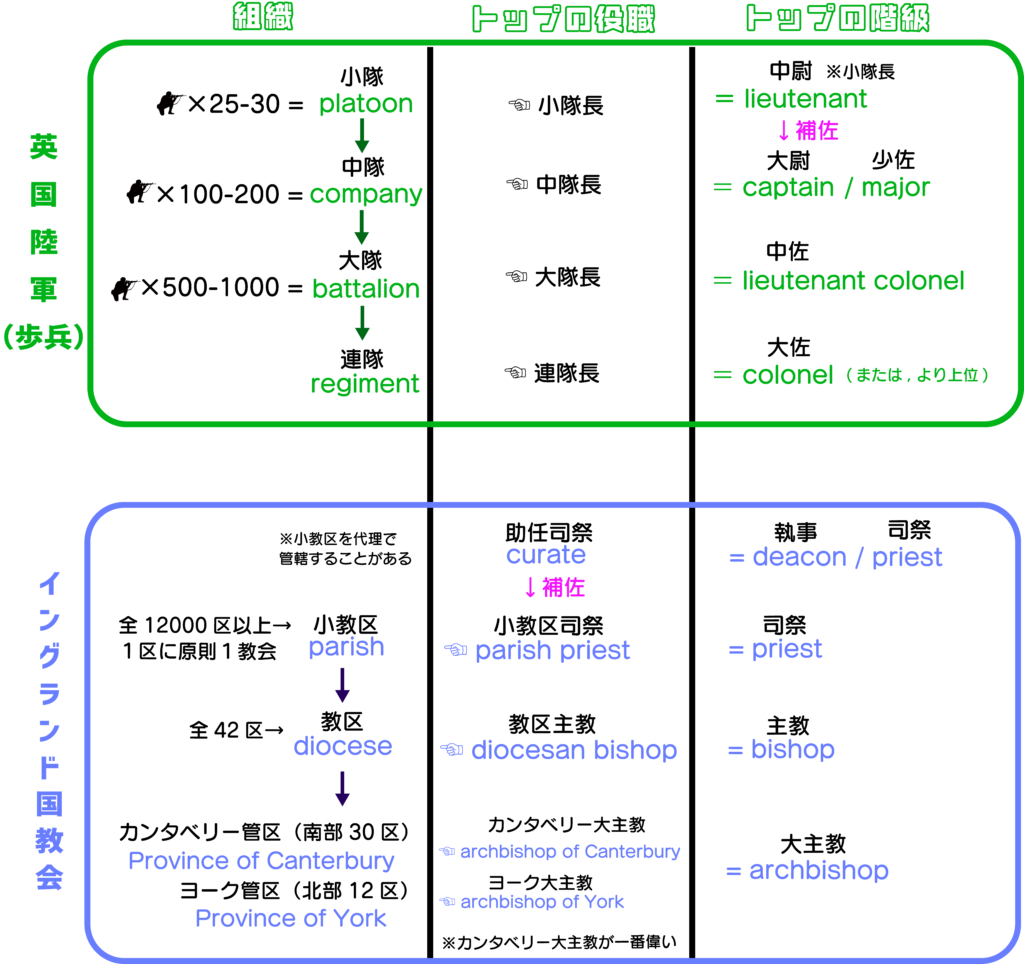
ありがと。ちょっと補足しておこう。
補足① 聖職者の位は、deacon(執事)→priest(司祭)→bishop(主教)の順番になっている。先述のように、この3つの位の順番を「Holy Orders」という。
そして、archbishop(大主教)は、主教の中でもさらに偉い階級だ。
なお参考までに、日本の正教会系では、Holy Ordersの三職の総称として「神品」という訳語を使ったりしている。
だから、正教会系で、聖職者任命の儀式を行うことは「神品機密を執行する」とよぶわ。
(正教会といえばロシアだから、正教会系はわたしが担当させてもらっていいわよね)
なんだそのフレーズは。かっこよさが他の中二ワードとは段違いだ!
だな!
あと補足②:小教区は全42の教区の下部組織にあたるぞ。教区もまた、南部の30教区はカンタベリー管区、北部の12教区はヨーク管区に属しているんだ。
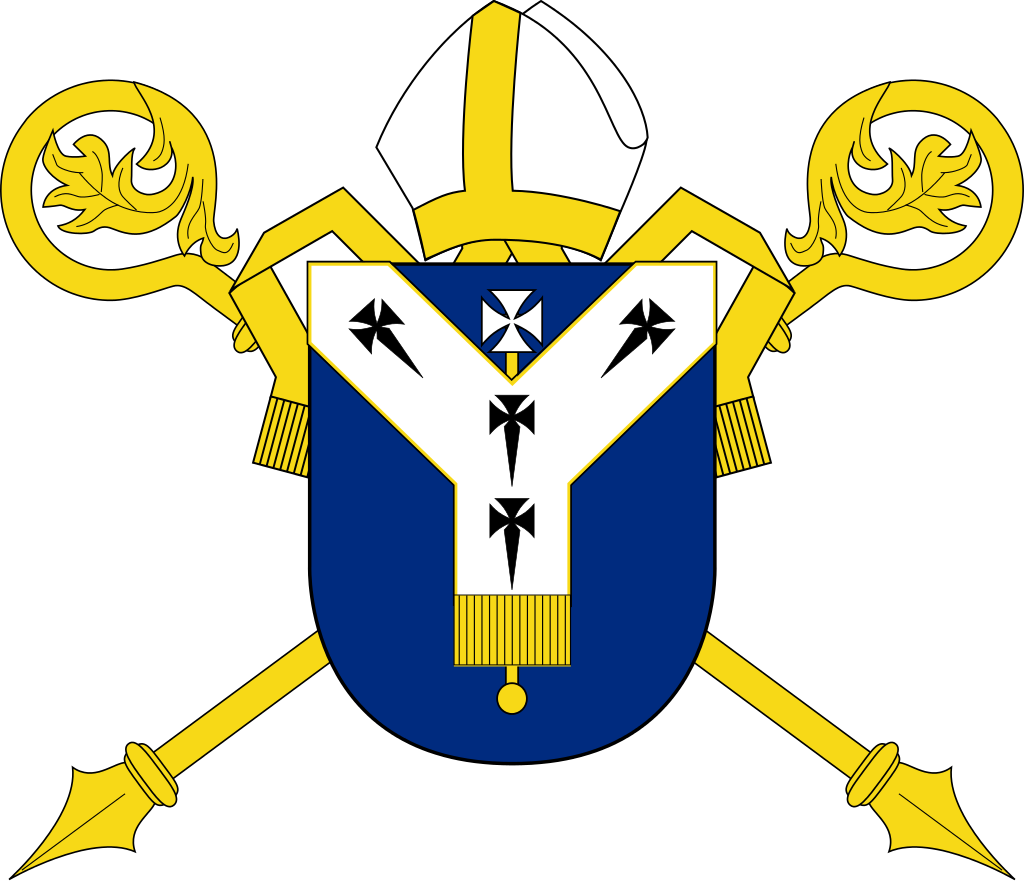
そして、カンタベリー管区のトップである「カンタベリー大主教」はイングランド国教会の事実上のトップでもあるぞ(厳密に言えば、国教会は国王がトップ)。21世紀でも貴族院に議席を有する役職だ。ここまで来ると逆に偉すぎるな。
(↓カンタベリー大主教の紋章)
問題編
After getting this sudden lesson in the power of terrestrial* weapons, the Martians retreated* to their original position upon Horsell Common; and in their haste, and encumbered* with the debris of their smashed companion*, they no doubt overlooked many such a stray* and negligible* victim ( ) myself. Had they left their comrade* and pushed on forthwith*, there was nothing at that time between them and London ( ) batteries* of twelve-pounder guns, and they would certainly have reached the capital ( ) advance of the tidings* of their approach; as sudden, dreadful*, and destructive* their advent* would have been as the earthquake that destroyed Lisbon a century ago.
terrestrial(<terra地球)地球上の retreat退却する encumber妨げる(be encumbered with~に妨げられる) companion仲間 stray迷子の・はぐれた negligible(<neglect) 取るに足らない comrade戦友 forthwithすぐに battery砲兵中隊 tidings知らせ(常に複数形) dreadful恐ろしい destructive(<destroy)破壊的な advent到来
1. 緑のmanyの後に省略されている一語は?
2. オレンジのカッコ内に入る前置詞一語は?
3. 紫のカッコの中に入る前置詞一語は?
4. 青のカッコの中に入る前置詞一語は?
5. 赤アンダーラインの文型表示は?
さて、最終文に「earthquake that destroyed Lisbon a century ago」とある。
これはもちろん、リスボン地震(1755年)のことだな。

ポルトガル沖で発生したM8.5~9.0の地震(関東大震災よりマグニチュードが大きい)で、さらに津波・火災も続き、ポルトガル首都のリスボンはほぼ完全に壊滅、数万人の死者が出たのだ…。
この地震はポルトガルだけでなくヨーロッパ全体に衝撃を与えたにゃ。政治・科学など様々な点で近代(1800年ごろからの時代)の制度が始まるきっかけになったのにゃ。
はるか遠くロシアまで影響を与えたと言われてるわ。
お、そうか。じゃあここ読んでくれ。
Она знает, например, про кой-кого из мордасовцев такие капитальные и скандалезные вещи, что расскажи она их, при удобном случае, и докажи их так, как она их умеет доказывать, то в Мордасове будет лиссабонское землетрясение.
↑ Дядюшкин сон (伯父さまの夢)(ドストエフスキー, 1859年)第1章より。赤色の部分が「リスボン地震」。
うう、う。いじわる。
よしよし。ロシア語はまだ読めないもんな。泣くな泣くな。英訳バージョンも示しとくから。
Maria Alexandrovna knew many deadly and scandalous secrets of certain other Mordasoff inhabitants, which, if she liked to reveal them at any convenient opportunity, would produce results little less terrible than the earthquake of Lisbon.
※Maria Alexandrovna:女性の名前。 Mordasoff:町の名前。
泣いてないもん!
ま、こちらの本でもリスボン地震が大惨事の比喩として使われていることがわかれば大丈夫じゃないかなぁ。
地震によって壊滅したポルトガル首都、火星人(天災だよね)によって壊滅するイギリス首都。当時のポルトガルは海上帝国、いまのイギリスも海軍王国。ほんとにぴったりの対比だな。
解答編
<英文解釈記号ルール>
〔〕→関係詞句・節
【】→接続詞句・節
《》→挿入句・節
[ ] →名詞句・節
()→副詞句・節
〈〉→形容詞句・節
(After getting this sudden lesson (in the power of terrestrial* weapons)), the Martians retreated* (to their original position upon Horsell Common); and (in their haste), and (encumbered* with the debris of their smashed companion*), they 《no doubt》 overlooked many 〈such a stray* and negligible* victim as myself〉. 【Had they left their comrade* and pushed on forthwith*】, there was nothing (at that time) (between them and London) but batteries* of twelve-pounder guns, and they would certainly have reached the capital (in advance of the tidings* of their approach); as sudden, dreadful*, and destructive* their advent* would have been as the earthquake 〔that destroyed Lisbon a century ago〕.
1. 緑のmanyのあとに省略されてる単語はpeople。many people…と続きます。
2. オレンジのカッコ内に入る前置詞一語はas。such A as B (BのようなA)の形ですね。
3. 紫のカッコの中に入る前置詞一語はbut。nothing but~(~以外なにもない)の形です。
4. 青のカッコの中に入る前置詞一語はin。in advance(前もって)ですね。
5. 赤アンダーラインの文型表示は、CSVの第二文型倒置っぽいやつです。CVSにすると動詞の塊(would have been)がでかすぎてめんどうなので、CSVの語順になったのかなぁと思います。
全訳
地球の兵器の威力を見せつけられ、突然手痛い思いをした火星人たちは、ホーセル共有地にある元の場所に退却した。彼らは急いでいたし、破壊された僚機の残骸がじゃまだったこともあり、わたしのように仲間とはぐれた取るに足らない多くの避難民を見落としていたに違いない。もし戦友を置いたままにして、すぐに進撃を続けていれば、このときロンドンへのルート上にいたのは12ポンド砲の数個中隊だけだったから、火星人襲来の知らせが届く前に確実に首都に到達していただろう。火星人ロボットが出現すれば、1世紀前にリスボンを壊滅させた地震と同じくらい青天の霹靂のことで、ひどく破壊的なものになったはずだ。
火星人、一度撃退してるんですね!
イギリス軍なら当然のことよ。
ま、火星人も、まさか1機でもやられるとは思っていなかったでしょうね。やられたロボットを運んだままさらに戦闘に突入するのは危険だし、こんなに早い段階で1機脱落するんだったら、ロンドンまでの距離を考えたときに、兵力不足だと判断したんだと思うわ。もう少し待てばあと5体の増援が来るはずだから、少し待機するという判断ね。
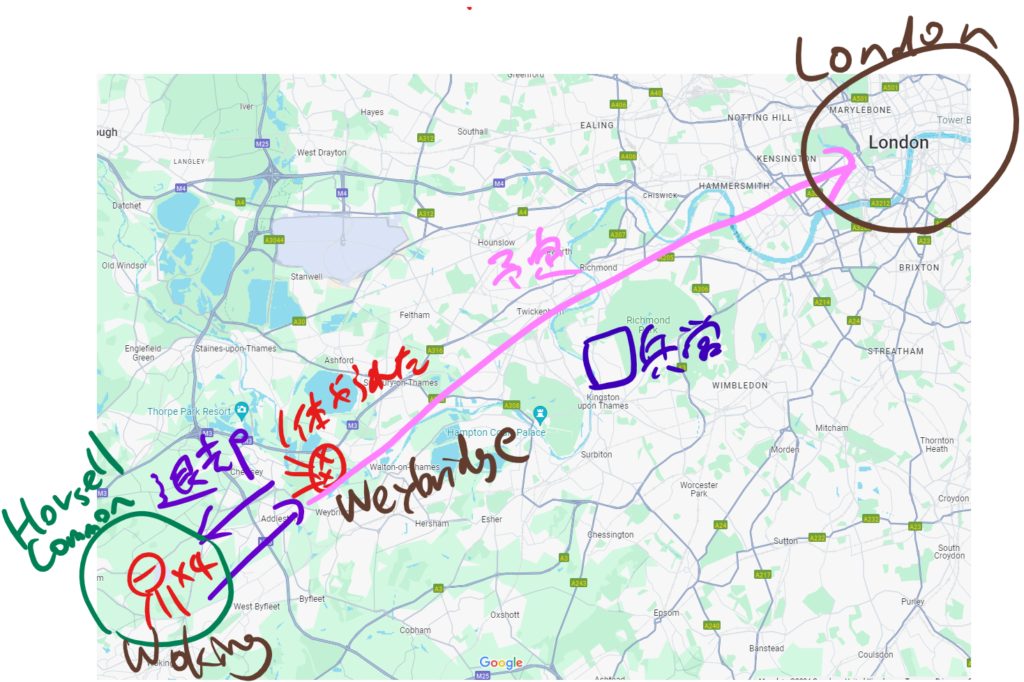
あと火星人から見れば、もっとすごい地球兵器があるかもしれないと警戒したのかもしれないわ。
実際のところ、これら12ポンド砲が地球兵器の最新鋭だし、ここからロンドンまでの行程でルート付近に兵営は1つしかないのよね(もっとも、このころには兵力は東方から十分補給されているとは思うけれど)。
第13章 第2段落 (第218話)
問題編
But they were in no hurry. Cylinder* followed cylinder on its interplanetary* flight; every twenty-four hours brought them reinforcement*. And meanwhile the military and naval* authorities*, now fully alive ( ) the tremendous power of their antagonists*, worked with furious* energy. Every minute a fresh gun came into position until, before twilight, every copse*, every row of suburban villas* on the hilly slopes about Kingston and Richmond, masked an expectant* black muzzle*. And through the charred* and desolated* area—perhaps twenty ( ) miles altogether—that encircled* the Martian encampment* on Horsell Common, through charred and ruined villages among the green trees, through the blackened and smoking arcades* that had been but a day ago pine spinneys*, crawled* the devoted scouts* with the heliographs* that were presently to warn the gunners ( ) the Martian approach. But the Martians now understood our command* of artillery* and the danger of human proximity*, and not a man ventured* within a mile ( ) either cylinder, save at the price of his life.
cylinder火星人の宇宙船 interplanetary(<inter+planet+ary)惑星間の reinforcement増援 naval(<navy)海軍の authority当局 antagonist(<ant+agonist)敵対者 furious猛烈な copse雑木林 villa大邸宅 expectant準備ができている muzzle銃口 char黒焦げにする desolate荒れ果てた encircle(<en+circle)取り囲む encampment(<en+camp+ment) 陣地 arcadeアーケード spinney雑木林 crawlこそこそ動き回る scout偵察兵 heliographヘリオグラフ command部隊 artillery砲兵 proximity近づくこと venture危険を冒して乗り込む
1. 緑のカッコに入る前置詞一語は?
2. 赤カッコの中に、「( ) miles」が「平方マイル」(マイルの2乗)という意味になるように一語を入れると?
3. オレンジのbutの意味は?
4. 茶色カッコに入る前置詞一語は?
5. 青アンダーラインの文型表示は?
6. 紫カッコに入る前置詞一語は?
7. 赤アンダーラインの解釈は?
地図はこちらです。
第12章でシェパートンの戦いに敗れた(?)火星軍は、いったんホーセル共有地に撤退してます。
ただ依然としてテムズ・ウェイ川以西を支配しているって状況です!
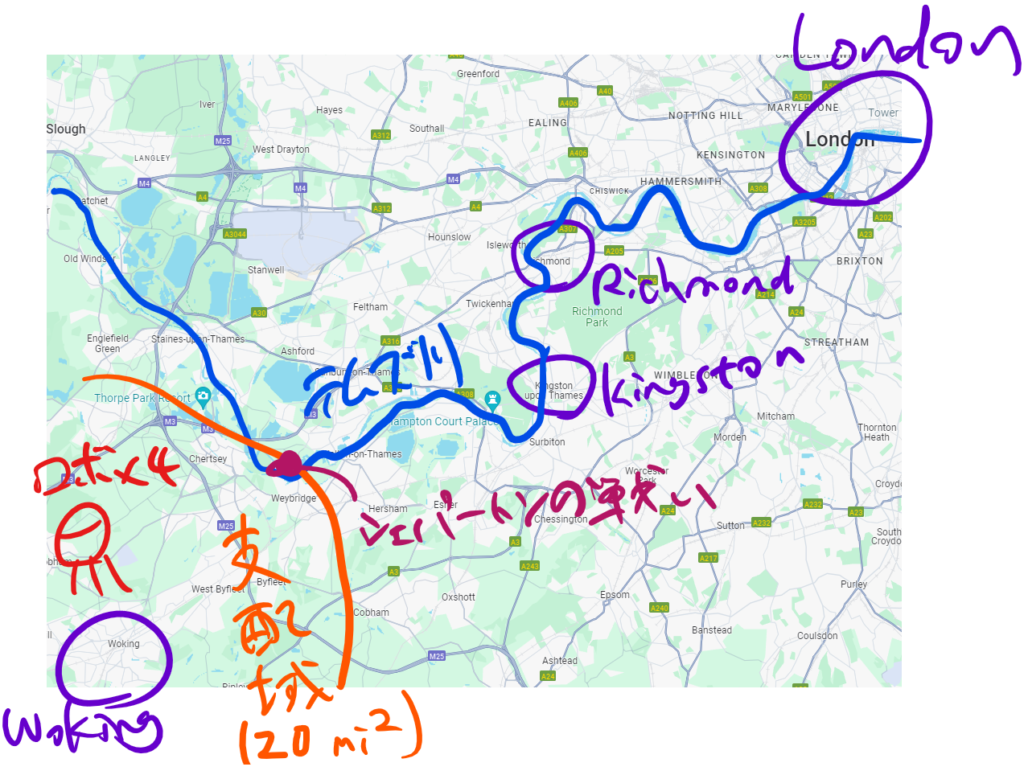
第二次侵攻の用意をしている段階ね。
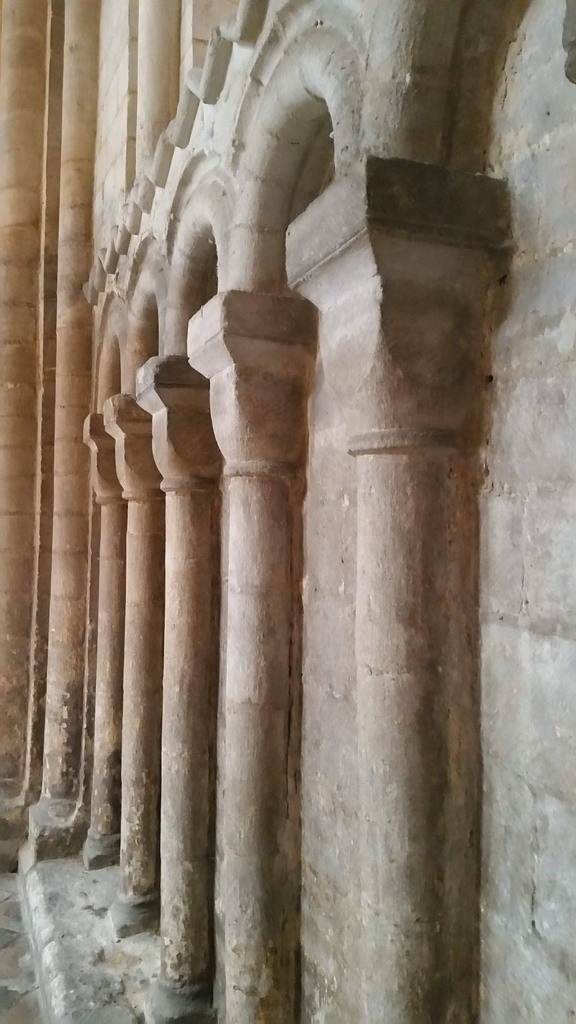
次に、「arcade」は、商店街の「アーケード」でもいいかもしれないけど、「拱廊(きょうろう)」という訳語がいちばん適切かしら。写真みたいに、アーチ状の構造が続いている廊下を指すわ。
ここでは、木が並んでいる様子がこんな風に見えた、ってことを言ってるのね。
解答編
<英文解釈記号ルール>
〔〕→関係詞句・節
【】→接続詞句・節
《》→挿入句・節
[ ] →名詞句・節
()→副詞句・節
〈〉→形容詞句・節
But they were (in no hurry). Cylinder* followed cylinder (on its interplanetary* flight); (every twenty-four hours) brought them reinforcement*. And (meanwhile) the military and naval* authorities*, 《now fully alive to the tremendous power of their antagonists*》, worked (with furious* energy). (Every minute) a fresh gun came into position 【until, 《before twilight》, every copse*, every row of suburban villas* 〈on the hilly slopes about Kingston and Richmond〉, masked an expectant* black muzzle*】. And (through the charred* and desolated* area《—perhaps twenty square miles altogether—》〔that encircled* the Martian encampment* on Horsell Common), (through charred and ruined villages among the green trees), (through the blackened and smoking arcades* 〔that had been but a day ago pine spinneys*〕), crawled* the devoted scouts* (with the heliographs* 〔that were presently to warn the gunners of the Martian approach〕). But the Martians now understood our command of artillery* and the danger of human proximity*, and not a man ventured* (within a mile of either cylinder), (save at the price of his life).
1. 緑のカッコに入る前置詞一語は、to。be alive to≒be aware of ですね。
2. 赤カッコの中に、入れると「squre」。2乗=square, 3乗=cubeなので、平方メートルは「square meter」、立方メートルは「cubic meter」ですね。
3. オレンジのbut≒only。「つい」くらいかな。
4. 茶色カッコに入る前置詞一語はof。warn A of Bで「AにBを警告する」ですね。
5. 青アンダーラインの文型表示は、crawledがV、the devoted scoutsがS。MVSの第一文型倒置ですね。
6. 紫カッコに入る前置詞一語はof。within 距離 of 場所 で「場所から距離以内」です。fromじゃなくてofなので気をつけましょう。
7. 赤アンダーラインの解釈はむずかしいところですが、まず at the price[cost] ofで「~を犠牲にして」。saveは動詞だとすると原型になっているのはおかしいので、接続詞のほう(≒only, except)です。直訳すれば「命を犠牲にするのを除けば」。直前との関係も踏まえると、「命が惜しかったら、むやみに宇宙船から1マイルのうちには入らなかっただろう」という感じでしょうか。
全訳
でも、火星人たちは急いではいなかった。なにせ、惑星間を次々と円筒宇宙船が飛んできて、24時間ごとに増援が得られるのだから。一方その間、陸軍・海軍当局は敵のすさまじい力が身に染みて、猛烈なエネルギーをふりしぼって働いた。毎分1門の砲が新たに配置につき、夕暮れ前には、キングストンやリッチモンド周辺の丘の斜面で、あらゆる雑木林・郊外邸宅の通りを、即応体制に入った黒い砲門が覆っていた。
ホーセル共有地の火星軍陣地の周囲のエリアは、おそらく合計20平方マイル(≒51㎢)くらい、焼かれて荒れ果てていただろう。そして、緑の木が残っているなかで、建物が真っ黒になり荒廃した村もいくつかあった。また、昨日は松の雑木林だったところは黒く煙を出すアーケードのようになっていた。そのように壊滅した土地の中を、熱心な偵察隊がこそこそ動いていた。偵察兵はヘリオグラフを持っており、それを用いて火星人接近をすぐに警告する手はずだった。ただ、火星人は既に地球の砲兵部隊の能力と、人間に近づくことの危険性を理解していた。それに、円筒宇宙船の1マイル以内に入り込んでやろうとする人は誰もいなかった。もしそんなことをすれば命はなかっただろう。
①「military and naval」と対比されているから、この「military」は「陸軍」だな。
②「…gun came into position until, before twilight…」とあるが、「~までに砲が配置についた」とすると日本語として変だ。untilは「ついに」などと訳す結果用法でとるといいだろう。
③「muzzle」は辞書的な意味だと「銃口」だが、これは大砲だからな。「砲門」って訳すんだぜ。
④ヘリオグラフは第181話参照。光学的な通信機器だったな。
第13章 第3段落 (第219話)
問題編
It would seem that these giants spent the earlier part of the afternoon ( ) going to and fro*, transferring everything from the second and third cylinders—the second in Addlestone Golf Links and the third at Pyrford—to their original pit on Horsell Common. Over that, above the blackened heather* and ruined buildings that stretched far and wide, stood one as sentinel*, while the rest abandoned their vast fighting-machines and descended into the pit. They were hard at work there far into the night, and the towering* pillar* of dense* green smoke that rose therefrom* could be seen from the hills about Merrow, and even, it is said, from Banstead and Epsom Downs.
to and fro行ったり来たり heatherヘザー(植物)(第22話) sentinel歩哨・警戒任務の兵 toweringそびえたつ pillar柱 dense濃密な therefrom(<there+from)そこから
1. 青のカッコの中に入る前置詞一語は?
2. オレンジのtoが修飾しているのは?
3. 赤のone, the restのあとに省略されている単語は(何が「1つ」・「残り」なの?)
4. 青アンダーラインの主語と動詞は?
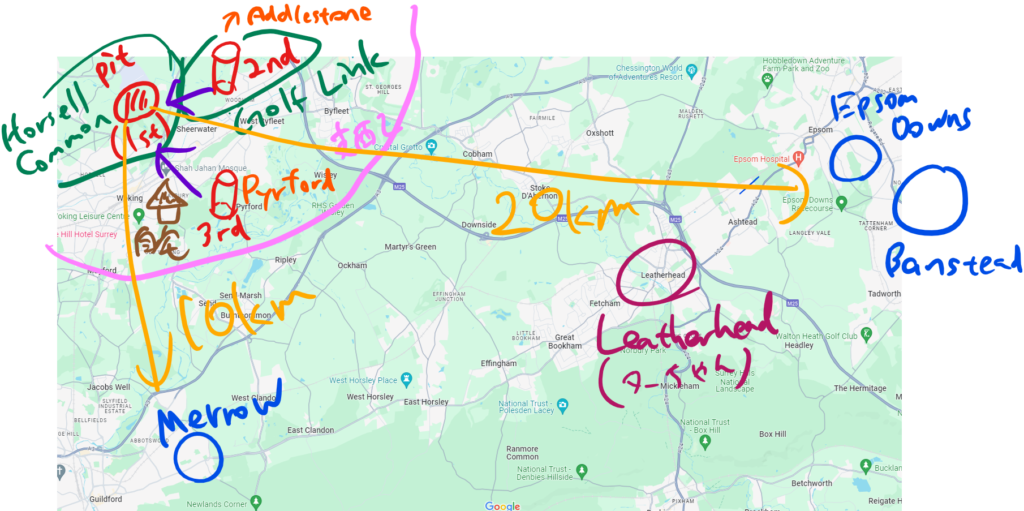
地図だ。
火星人は2st, 3rd宇宙船から物資を持ち出してホーセル共有地に移し、陣地防衛を強化しているってとこだな。あるいは、人員を効率的に運用したかったからかもしれないが…。
そこからMerrowまでは10㎞、EpsomとBansteadは20㎞といったところだ。
以下の三重大学の実験によれば、煙は通常10㎞くらいまで見えるとのこと。それで20㎞というのはかなり鮮やかな色ってことだろう。

イングランドは平地だから見えやすいわよね。
わたしがいるところ(Leatherhead)からも見えたに違いないわ。
ひとつ思ったんだが、ここに「4th cylinder」と「5th cylinder」の記述はどこにもないし、時系列的にも、3rd cylinderが落下したのは土曜の夜だからまだ1日経ってないはずなんだ(宇宙船は1日1隻ずつ発射されている)。だからまだ宇宙船は3隻のはず。でもロボットは5体いたよな。
そこで、1隻の宇宙船に2体ロボットが積みこんであったと考えるのはどうだろうか。1体は陣地防衛用に残して、5体でロンドン攻撃を敢行したのだとしたら辻褄もあう。
冴えてるじゃん。
解答編
<英文解釈記号ルール>
〔〕→関係詞句・節
【】→接続詞句・節
《》→挿入句・節
[ ] →名詞句・節
()→副詞句・節
〈〉→形容詞句・節
It would seem that these giants spent the earlier part of the afternoon in going (to and fro)*, (transferring everything (from the second and third cylinders《—the second in Addlestone Golf Links and the third at Pyrford—》)(to their original pit on Horsell Common)). (Over that), (above the blackened heather* and ruined buildings 〔that stretched (far and wide)〕, stood one (as sentinel)*, 【while the rest abandoned their vast fighting-machines and descended into the pit】. They were hard (at work) (there) (far into the night), and the towering* pillar* of dense* green smoke 〔that rose therefrom*〕 could be seen (from the hills about Merrow), and even, 《it is said》, (from Banstead and Epsom Downs).
1. 青のカッコの中に入る前置詞一語は、inもしくはon。どちらでもOKです。spend O <in[on]> A(AでOを費やす)ですね。
2. オレンジのtoが修飾しているのは、transferring。
3. 赤のone, the restのあとに省略されている単語はMartian(火星人)。ロボットとしてしまうと、the restのあとがおかしくなります。
4. 青アンダーラインの主語はone、動詞はstood。MVSの第一文型倒置です。
なお補足ですが、as sentinelのように、asのあとの名詞は無冠詞でもOKなことがあります。
全訳
午後の早い時間帯、これらの巨大ロボは、2番目と3番目の円筒宇宙船に積載してあるものをホーセル共有地の最初の宇宙船着陸地へと運ぶのに行ったり来たりしていたのだろう。2隻目はアドレストンの方のゴルフリンク、3隻目はパーフォードに着陸していたん。さらに、真っ黒になったヘザーの野原や崩れた建物が延々と続いていたが、その上に一人の火星人が警戒のために立っていた。その間、残りの火星人は巨大な戦闘ロボットから降り、着陸地点のクレーターへと入って行った。そこで深更まで懸命に作業をしており、そこから濃密な緑の煙の柱が高くのぼるようすは、メロウのあたりの丘からはもちろん、バンステッドとエプソム・ダウンズからも見られたと言われている。
ここは日曜の夜なんだからね。
時系列がそこそこはやく動いてることに注意しなさいよ。
第13章 第4・5段落 (第220話)
問題編
And while the Martians behind me were thus* preparing for their next sally*, and in front of me Humanity* gathered for the battle, I made my way with infinite pains and labour* from the fire and smoke of burning Weybridge towards London.
I saw an abandoned boat, very small and remote, drifting* down-stream*; and throwing off* the most of my sodden* clothes, I went after it, gained it, and so escaped out of that destruction. There were no oars* in the boat, but I contrived* to paddle*, as well as my parboiled* hands would allow, down the river towards Halliford and Walton, going very tediously* and continually* looking behind me, as you may well understand. I followed the river, because I considered that the water gave me my best (escape, return, giants, of, chance, should, these).
thusこのように sally急襲 Humanity人類 labour労苦 drift漂流する down-stream下流へ throw off投げ捨てる soddenびしょ濡れの oarオール contrive to VなんとかVする paddleこぐ parboil半ゆでにする(<boil) tediously退屈なほど continually頻繁に
1. 緑のHumanityの意味は?
2. ピンクのtowardsがかかっているのは?
3. オレンジのitが指しているものは?
4. 赤のandが繋いでるものは?
5. 青のas well asの意味は?
6. 紫のandが繋いでるものは?
7. 赤アンダーラインを訳すと?
8. 青アンダーラインの単語を並び替えると?
Mapですにゃ。HallifordとWaltonはすぐ近くのテムズ河畔の町ですにゃ。
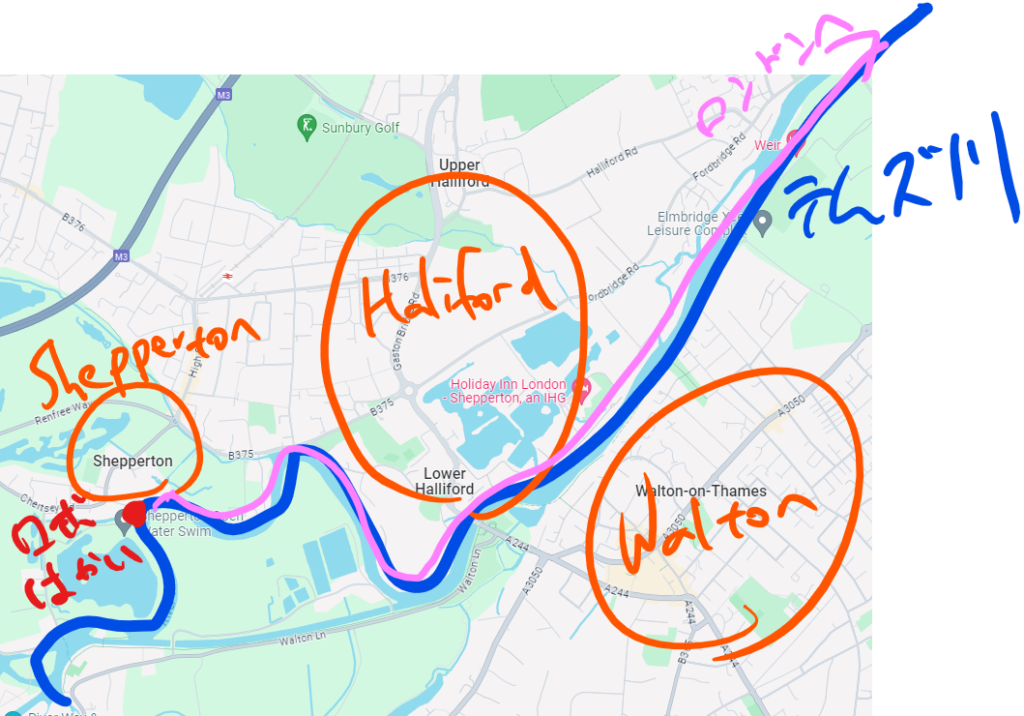
解答編
<英文解釈記号ルール>
〔〕→関係詞句・節
【】→接続詞句・節
《》→挿入句・節
[ ] →名詞句・節
()→副詞句・節
〈〉→形容詞句・節
And 【while the Martians 〈behind me〉 were (thus*) preparing (for their next sally*)】, and (in front of me) Humanity* gathered (for the battle)】, I made my way (with infinite pains and labour*) (from the fire and smoke of burning Weybridge) (towards London).
I saw an abandoned boat, 《very small and remote》, drifting* (down-stream*); and (throwing off* the most of my sodden* clothes), I went after it, gained it, and so escaped out of that destruction. There were no oars* in the boat, but I contrived* to paddle*, 《as well as my parboiled* hands would allow》, (down the river towards Halliford and Walton), (going very tediously*) and (continually* looking behind me), 〔as you may well understand〕. I followed the river, 【because I considered [that the water gave me my best chance of escape 【should these giants return】]】.
1. 緑のHumanityの意味は「人類」あたり。Martiansと対比です。
2. ピンクのtowardsがかかっているのは、made my way。
3. オレンジのitが指しているものは、an abandoned boat。
4. 赤のandが繋いでるものは、went, gained, escaped。
5. 青のas well asの意味は「~の限り」(≒as far as)。
6. 紫のandが繋いでるものは、goingとlooking(2つの分詞構文)。
7. 赤アンダーラインのasはwhichと一緒で、前文の内容をうける関係代名詞。may wellは「もっともだ」というよりは、「十分そうしうる」という意味(mayの強調)かな。
8. 青アンダーラインの単語を並び替えると上の通り。if省略の仮定法(should)です。
全訳
そして、後方では火星人がこのように次の急襲準備をしており、前方では人類が戦闘のために集まってきているという間、わたしはこの上ない苦痛を覚えながら、炎上しているウェイブリッジの火と煙から逃げ、ロンドン方面へと懸命に進んで行った。遠くで小さく、捨てられたボートが下流に向かって漂流しているのが目に入ったので、濡れた服はほとんど脱ぎ捨てて、ボートを追いかけ、つかまえた。そうしてこの破壊された町から逃れることができた。ボートにオールは積まれていなかったが、半分やけどしている手で可能な限りなんとか漕いで、ハリフォードとウォルトンの方へ下って行った。退屈なほど長い時間漕ぎつづけ、途中しきりに振り返った。そうした理由は君もよくわかるだろう。わたしは川の流れを利用していった。もしあんな巨大ロボが戻ってきたら、水があれば助かる可能性が最も高いと思っていたからだ。
わたし、熱水でやけどしてるからな。
第13章 第6段落 (第221話)
問題編
The hot water from the Martian’s overthrow* drifted* downstream with me, so that for the best part of a mile I could see little of either bank. Once, however, I made out a string* of black figures hurrying across the meadows* from the direction of Weybridge. Halliford, it seemed, was deserted, and several of the houses facing the river were on fire. It was strange to see the place quite tranquil, quite desolate* under the hot blue sky, with the smoke and little threads* of flame going straight up into the heat of the afternoon. (seen, before, burning, I, had, without, houses, never) the accompaniment* of an obstructive* crowd. A little farther on the dry reeds* up the bank were smoking and glowing, and a line of fire inland* was marching steadily across a late field of hay*.
overthrow打倒 drift漂う a string of一列の meadow牧草地 tranquil平穏な desolate人気(ひとけ)がない thread糸(状のもの) accompaniment付属するもの obstructive邪魔な reedアシの原 inland(川から)離れたところ hay干し草(第129話参照)
1. 紫のso thatの意味は?
2. 赤アンダーラインの訳は?
3. オレンジのitが指すものは?
4. 青アンダーラインの単語を並び替えると?文頭に来る文字も小文字にしてある。
5. 緑のan obstructive crowdって何のこと?
6. 赤のlateの意味は?
最終文に「a late field of hay」ってあるけど、アメリカ北西地方(ワシントン州など)での干し草の収穫スケジュールを持ってきたよ!
干し草は牧草のことだから、「アルファルファ(Alfalfa)」(一行目)とかの文字が見えるね!
初夏から夏にかけて収穫するみたい! たしかに「late」の表現は小説中の季節(6月)にマッチするね!
https://www.andersonhay.com/product/harvest-schedule/
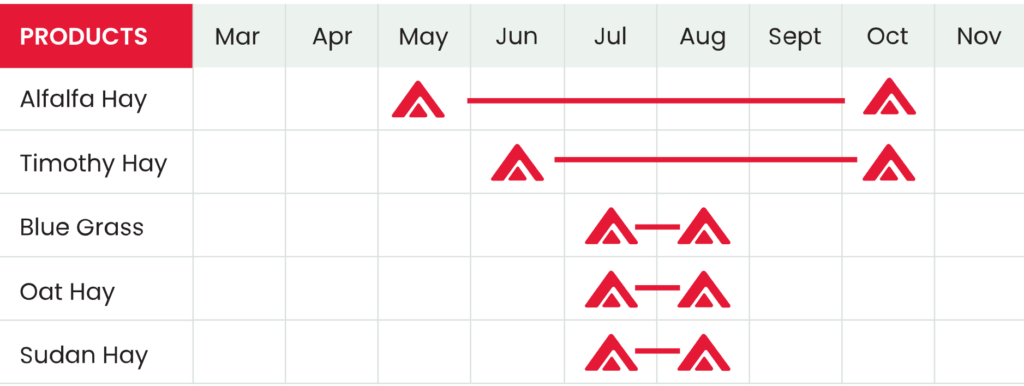
アメリカ北部とロンドンは緯度こそだいたい同じ(50°N)くらいだとはいえ、他の条件が違ってくるからこのスケジュールが全てとは限らないけどね。
解答編
<英文解釈記号ルール>
〔〕→関係詞句・節
【】→接続詞句・節
《》→挿入句・節
[ ] →名詞句・節
()→副詞句・節
〈〉→形容詞句・節
The hot water 〈from the Martian’s overthrow*〉 drifted* (downstream) (with me), so that (for the best part of a mile) I could see little of either bank. (Once), 《however》, I made out a string* of black figures hurrying across the meadows* (from the direction of Weybridge). Halliford, 《it seemed》, was deserted, and several of the houses 〈facing the river〉 were on fire. It was strange [to see the place quite tranquil, quite desolate* (under the hot blue sky), (with the smoke and little threads* of flame going straight up (into the heat of the afternoon)]. Never before had I seen houses burning (without the accompaniment* of an obstructive* crowd). (A little farther on) the dry reeds* up the bank were smoking and glowing, and a line of fire inland* was marching steadily (across a late field of hay*).
1. 紫のso thatは結果用法。「そのせいで」「だから」くらいで訳しておくといいのかな。
2. 赤アンダーラインは、the best part of≒most of。「a mile」について、「1マイル」の長さを地図で見てあげると、乗船場所から下船場所までの道のりが1マイルほどだったので、ここは訳さないか、「道中」くらいで訳しました。あと、littleは準否定ですね。eitherは否定と結びついて「どちらも~ない」。
3. オレンジのitが指すものは、to以下。
4. 青アンダーラインの単語を並び替えると上の通り。never~without…「~するときはいつも…する」と倒置のセットです。
5. 緑のan obstructive crowdは、要するに「野次馬」。
6. 赤のlateの意味は「晩期の」あたり。収穫目前ってことですね。
全訳
ロボットが倒されて湧きあがった熱水はわたしの近くまで流れてきていた。だからほとんど両岸が見えなかった。ただ、いちどだけ、一列に並んだ黒い人影がウェイブリッジの方から来て牧草地を横切って走っているのがわかった。ハリフォードから人は消えており、川に面した家のうち数軒は燃えていた。暑い青空の下、ここがまったくもって平穏で人気がないのは奇妙なことだった。炎の混じった煙がまっすぐに立ち上り、午後の暑い空にとけていった。火事現場で野次馬がいないのは初めてだった。すこし進むと、土手の上の乾いたアシが煙と炎を上げていた。それより内陸では長く広がった火炎が、晩期の干し草畑を着々と灰に変えていた。
第13章 第7段落 (第222話)
問題編
For a long time I drifted*, so painful and weary* was I after the violence I had been through, and so intense* the heat upon the water. Then my fears got the better of me again, and I resumed* my paddling*. The sun scorched* my bare* back. At last, as the bridge at Walton was coming into sight round the bend*, my fever and faintness overcame my fears, and I landed on the Middlesex bank and lay down, deadly sick, amid* the long grass. I suppose the time was then about four or five o’clock. I got up presently*, walked perhaps half a mile without meeting a soul, and then lay down again in the shadow of a hedge*. I seem to remember talking, wanderingly*, to myself during that last spurt*. I was also very thirsty, and bitterly* regretful I had drunk no more water. It is a curious thing that I felt angry with my wife; I cannot account for it, but my impotent* desire to reach Leatherhead worried me excessively*.
drift漂流する weary疲れて intense激しい resume再開する paddle(船を)こぐ scorch焦がす bend川の曲がったところ bare裸の amid≒among presentlyすぐに hedge生垣 wanderinglyあてもなく歩きながら last spurtラストスパート bitterly痛烈に impotent(<im+potent)無力な excessively(<ex+cess+ive+ly)過度に
1. 赤アンダーラインの文型表示は?
2. 青アンダーラインで省略されている単語を補って訳すと?
3. オレンジのget the better ofの意味は?
4. 赤のthe Middlesex bankは川の右岸?左岸?
5. 紫のsoulの意味は?
6. 緑のandが繋いでるものは?
7. 茶色のaccount forの意味は?
問題にもなってるけど、「Middlesex」はイギリスの「county」の1つね。
「country」?構成国のことかしら?
「country」じゃなくて「county」(カウンティ)よ。
行政区分ね。ざっくりと都道府県みたいなものだと思えばいいわ。
イングランド南東部はこんな区分になっているわ。
https://wikishire.co.uk/map/#Middlesex/centre=51.844,-1.352/zoom=9
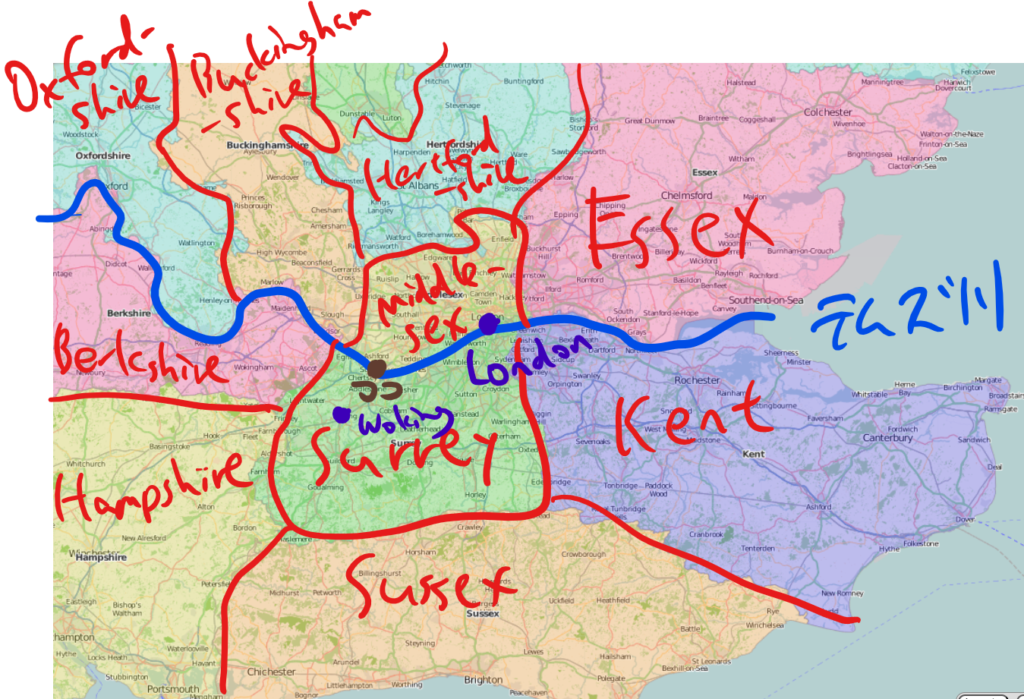
な、なにこれ。語尾に「-sex」がつく地名がいっぱいあるじゃない(Essex, Middlesex, Sussex)。わたしたちは全年齢向けコンテンツのはずよ。
待て待て。「-sex」の語尾は、サクソン人(現代英語Saxon=中英語Sæxe=古英語Seaxe)に由来するものだぞ。「南にあるサクソン人の土地」で、South+sex=Sussexというふうになったわけだな。
ゲルマン民族大移動によってアングロ=サクソン人がイングランドに入り、いくつかの国を作ったんだったわよね。その七王国のころから「Sussex」「Wessex」「Essex」という地名(国名)が存在するわ。
し、知ってたわよ。いちおう念のため聞いてみただけよ。
読者の皆様、わたしたちは常に正しくまともな情報をお届けしますのでご安心くださいませ。
ちなみに「shire」と語尾につくカウンティも多くありますが、「shire」(シャイア)は
「county」の前身行政区分でした。
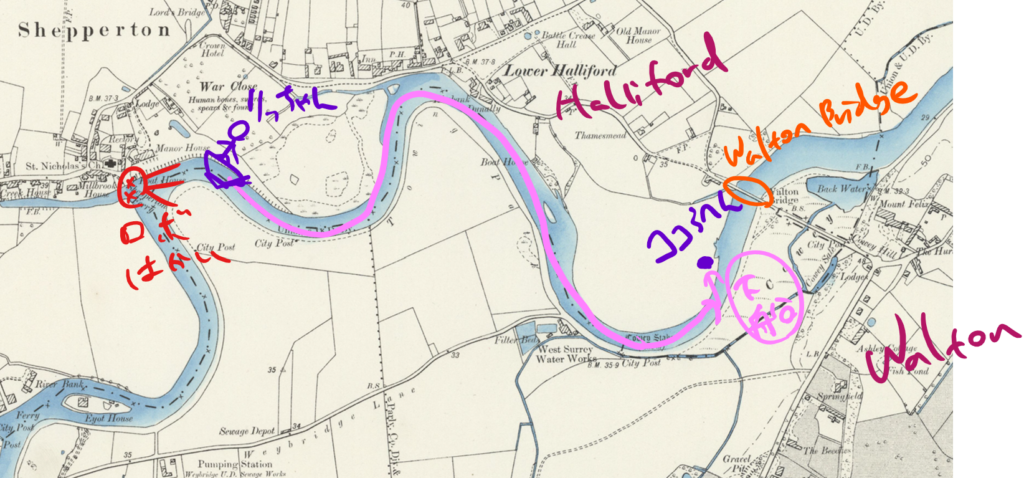
ともあれ、現場付近を拡大してみるとこんな地図になります。おおむねテムズ川でMiddlesexとSurreyが分かれているわけですね。
だから「the Middlesex bank」は、川の左岸になります。
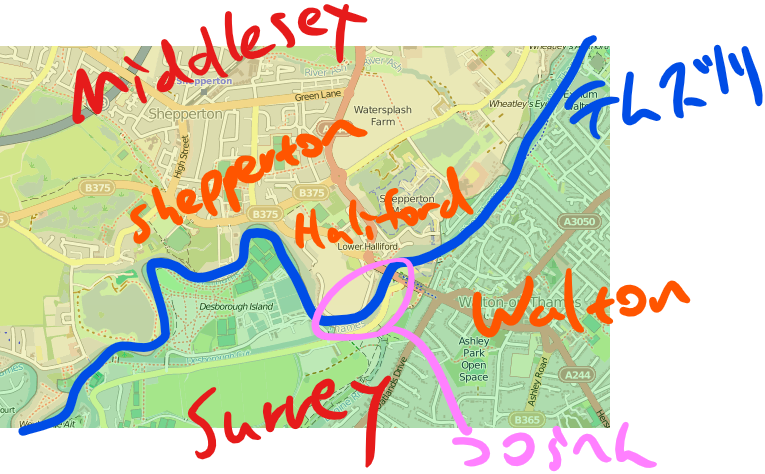
時間と場所を整理すると、いまは日曜午後4時~5時で、Walton Bridge付近のテムズ川左岸にいるってことですにゃ。
ねぇ、背中が日焼けしてるって書いてる(The sun scorched my bare back)けど、だいじょぶそ? 服着てる?
メタい話になるから気にしない気にしない。
ちなみに一応書いておくけど、19世紀後半で女性は「コルセット」(腰のくびれを作るために人為的に締め付ける下着)をつけるのが主流だな。装着が面倒だし、健康的・文化的価値観の変化もあって、20世紀にはいると廃れてしまうんだけど…。

そそ。20世紀に入らないとブラもないからな。
解答編
<英文解釈記号ルール>
〔〕→関係詞句・節
【】→接続詞句・節
《》→挿入句・節
[ ] →名詞句・節
()→副詞句・節
〈〉→形容詞句・節
(For a long time) I drifted*, so painful and weary* was I (after the violence 〔I had been through〕), and so intense* the heat upon the water). Then my fears got the better of me again, and I resumed* my paddling*. The sun scorched* my bare* back. (At last), 【as the bridge at Walton was coming into sight (round the bend*)】, my fever and faintness overcame my fears, and I landed (on the Middlesex bank) and lay down, (deadly sick), (amid* the long grass). I suppose [the time was then about four or five o’clock]. I got up (presently*), walked perhaps half a mile (without meeting a soul), and then lay down again (in the shadow of a hedge*). I seem to remember talking, 《wanderingly*》, to myself (during that last spurt*). I was also very thirsty, and bitterly* regretful I had drunk no more water. It is a curious thing [that I felt angry (with my wife)]; I cannot account for it, but my impotent* desire to reach Leatherhead worried me excessively*.
1. 赤アンダーラインの文型表示は、第二文型倒置CVSですね。Iが代名詞だから、CSV前置、すなわち「so painful and weary I was…」とするのが文法上正しいはずですが、soーthat構文では絶対倒置が起こる(CSVのsoーthatはない)のに引きずられたんでしょうか。
2. 青アンダーラインは、so intense was the heat…となるのがもともと。andの前と同じ構造をしているので、wasが消えていったんだと思います。
3. オレンジのget the better ofの意味は「打ち勝つ」「支配する」(≒defeat)。
4. 赤のthe Middlesex bankは左岸。上の解説通り。
5. 紫のsoulの意味は「人」。
6. 緑のandが繋いでるものは、got up, walked, lay。
7. 茶色のaccount forの意味は「~を説明する」。ほかにも「~を占める」という意味もある多義語です。
全訳
長い間、わたしは流れに舟を任せていた。さきほどの凄烈な経験を経てたいそう苦痛と疲労がたまっており、水面の上の熱もすさまじかったからだ。だがその後わたしはまた恐怖に支配され、手で漕ぐのを再開した。太陽は背中を焼くように差していた。とうとう、蛇行部を経てウォルトン橋が視界に入ると、恐怖より熱とめまいを感じるようになった。そして左岸に舟をつけ、死ぬほど気分が悪くなって、長い草の中に倒れこんだ。そのときは午後4時か5時ごろだったと思う。わたしはすぐに立ち上がり、誰にも会うことなくおそらく半マイルほど歩き、生垣のかげでまた倒れこんだ。倒れる間際、ふらふらしながら、自分に何か語り掛けたような気もする。また、とてものどがかわいており、どうしてあれだけしか水を飲まなかったのかと苦々しく後悔した。ターちゃんに怒りを感じたのは不思議なことだ。その理由の説明はできないが、レザーヘッドにたどり着きたいという実現不可能な願いのせいで、過度に不安になっていた。
ちょっと。なんでわたしに怒ってるのよ。
八つ当たりしたくなるもんさ。
混乱した感情を向ける相手が奥様とは、ずいぶんと夫婦仲がよろしいようで。
第13章 第8段落 (第223話)
とゆーことで、この段落からわたし(curate=助任司祭)が登場するわ。
問題編
I do not clearly remember the arrival of the curate, so that probably I dozed*. I became aware of him as a seated figure in soot-smudged* shirt sleeves*, and with his upturned*, clean-shaven* face staring at a faint flickering that danced over the sky. The sky was what is called a mackerel sky—rows and rows of faint down-plumes* of cloud, just tinted* with the midsummer sunset.
I sat up, and at the rustle* of my motion he looked at me quickly.
“Have you any water?” I asked abruptly*.
He shook his head.
“You have been asking for water for the last hour,” he said.
dozeうたたねをする soot-smudgedすすで汚れた sleeve袖 upturned上を向いた clean-shavenひげのない down-plumeダウンの羽毛 tint染める rustleがさがさ音を立てる abruptly唐突に
1. オレンジの so thatの意味は?
2. 青アンダーラインはwith O Cの形だけど、Cにあたるのはどこから?
3. 赤アンダーラインのshake one’s headの意味は?
「mackerel sky」はこんな感じの曇り空ね。
「mackerel」は「サバ」よ。サバの模様みたいだからってことらしいわ。
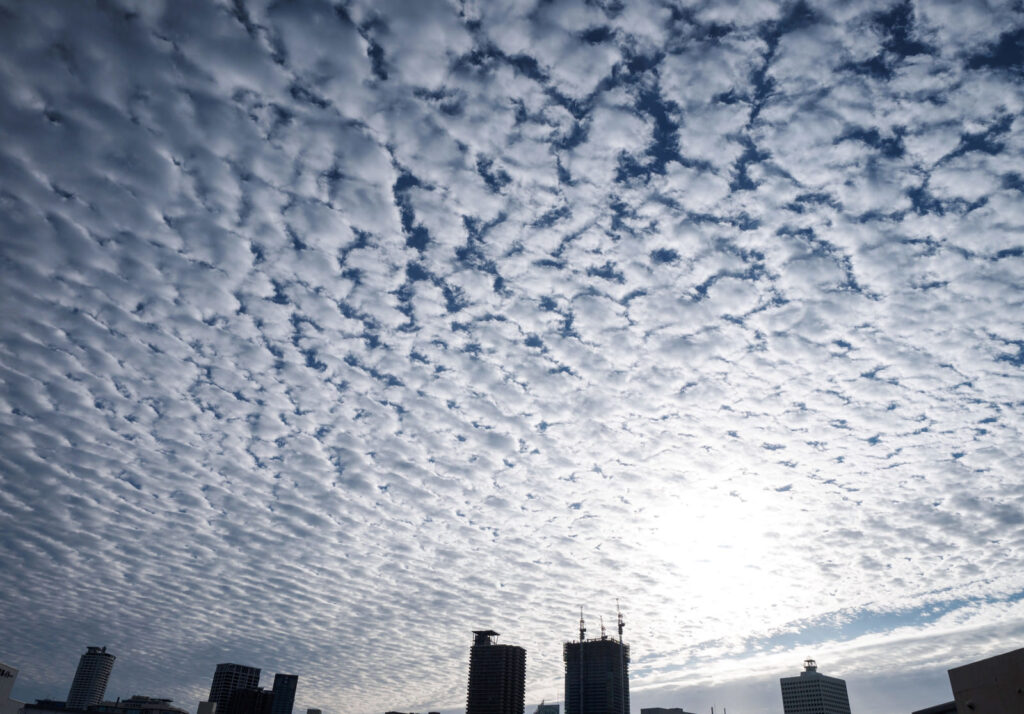
日本だと「いわし雲」とか「うろこ雲」という名前が一般的ですね!
「さば雲」という言葉もあるみたいですけど。
ちなみに、今の時間は「midsummer sunset」と書いてあるから、つい18時ごろだと思っちゃうけど、イギリスで真夏の日没は21時くらいになることもあるわ。
だから、いまはだいたい19時~20時ごろね。
解答編
<英文解釈記号ルール>
〔〕→関係詞句・節
【】→接続詞句・節
《》→挿入句・節
[ ] →名詞句・節
()→副詞句・節
〈〉→形容詞句・節
I do not clearly remember the arrival of the curate, so that (probably) I dozed*. I became aware of him (as a seated figure 〈in soot-smudged* shirt sleeves〉)*, and (with his upturned*, clean-shaven* face staring (at a faint flickering 〔that danced over the sky〕). The sky was [what is called a mackerel sky]—rows and rows of faint down-plumes* of cloud, (just tinted* with the midsummer sunset).
I sat up, and (at the rustle* of my motion) he looked at me quickly.
“Have you any water?” I asked abruptly*.
He shook her head.
“You have been asking for water for the last hour,” he said.
1. オレンジの so thatの意味は、ここでは辞書にはないけど、becauseと同じ意味かな(理由を表す)。
2. 青アンダーラインはwith O Cの形で、Cにあたるのはstaringから。flickeringは「明滅するもの」という名詞ですね。
3. 赤アンダーラインのshake one’s headは「首を横に振る」「いいえと言う」。反対にうなずくときは「nod」ですね。
全訳
助任司祭がわたしのもとに来たところははっきりとは覚えていない。おそらくわたしはうたたねをしていたのだろう。やがて、誰かが袖がすすでよごれたシャツを着て座ってるのに気づいた。それが出会いだった。助任司祭は上を向いて、ひげのない顔で、かすかに明滅する光が空の向こうに踊っているのを見つめていた。このときの空はいわゆるうろこ雲だった。かすかなダウンの羽毛のような雲が何列にも連なり、ちょうど真夏の日没で染まっていた。
わたしは身を起こし、その際にガサガサ音を立てたことで助任司祭はすぐにわたしを見た。
「み、水あるか?」とわたしは唐突に聞いた。
助任司祭は首を横に振った。
「あんた、この1時間ずっと寝言で『水くれー』って言ってたじゃない」と。
「Have you any water?」というセリフがあるが、イギリスでは「Do you have…」を「Have you…」と言うこともあるからな(口語)。覚えておこう。
第13章 第9段落 (第224話)
わたしたちの描写についてちょっと違う面もあるかもしれないが、しかたないと思って乗り切って行こう。
問題編
For a moment we were silent, taking stock of* each other. I dare say he found me a strange enough figure, naked, save for my water-soaked* trousers and socks, scalded*, and my face and shoulders blackened by the smoke. His face was a fair* weakness, his chin* retreated*, and his hair lay in crisp*, almost flaxen* curls* on his low forehead*; his eyes were rather large, pale blue, and blankly* staring. He spoke abruptly, looking vacantly away from me.
“What does it mean?” he said. “What do these things mean?”
I stared at him and made no answer.
He extended a thin white hand and spoke in almost a complaining tone.
“Why are these things permitted? What sins* have we done? The morning service* was over, I was walking through the roads to clear my brain for the afternoon, and then—fire, earthquake, death! As if it were Sodom and Gomorrah! All our work undone, all the work—— What are these Martians?”
“What are we?” I answered, clearing my throat*.
take stock ofよく思いを巡らす soaked濡れた scaldedやけどをして fair色白の chinあご retreat後退する in crisp縮れる flaxen亜麻色の(アンドリューシャちゃんの立ち絵の髪色と同じ) curlカール(巻き毛) forehead(<fore前に+head)額 blankly虚ろに sin宗教的な罪 morning service朝の祈り clear one’s throatせきばらいをする
1. 青のI dare sayの意味は?
2. オレンジのfoundの意味は?
3. 紫のsave forの意味は?
4. 赤のratherの意味は?
5. 緑のoverの意味は?
わたしの描写について、巻き毛の髪ってとこだけは、GuP原作と宇宙戦争原作で違ったわね。白い顔、亜麻色の髪、青い目、そのあたりはパーフェクトよ。
性格については、我を押すところと口数がいちいち多いところは似てる気もするが、宇宙戦争で描かれている「curate」のキャラ設定は、ひたすら神に祈っている、信仰心の篤い宗教家だ。
この段落でも、「What sins have we done(何の罪を犯したというのですか)」と言っていたり、「As if it were Sodom and Gomorrah!(ソドムとゴモラのようだ)」と言ったりしているにゃ。
ソドムとゴモラは聖書に出てくる町ですよね。これくらいはわかりますよ。
性が乱れてたから、神が怒って滅ぼした町でしたっけ。
そうね。神の火に焼かれたといわれているわ。
このころのイギリスは風俗的にそんなに乱れてたわけじゃないんだけどね。
ソドムとゴモラが書かれてる聖書の巻は「創世記」です。そこそこエピソードが長いので、滅びの場面だけコピペしておきますね。
ちな、聖書の日本語訳は、適当にネットで見つけたのをそのままコピペしてるだけです。基本的によくわからない怪しいウェブサイトが出典ですが、聖書の内容までは変わってないと思いまして。
創世記(Genesis)第19章 24節~25節
[24] Then the LORD rained on Sodom and Gomorrah sulfur and fire from the LORD out of heaven. [25] And he overthrew those cities, and all the valley, and all the inhabitants of the cities, and what grew on the ground. (ESV/標準英語訳聖書)
引用元:https://www.esv.org/Genesis+19/
[24] 主は硫黄と火とを主の所すなわち天からソドムとゴモラの上に降らせて、 [25] これらの町と、すべての低地と、その町々のすべての住民と、その地にはえている物を、ことごとく滅ぼされた。
http://bible.salterrae.net/kougo/html/genesis.html
ちなみに、おなじ「創世記」にある「ノアの方舟」エピソードと重なる部分がいっぱいあるよ!神に忠実な人間を救う代わりに、神に従わない人間を滅ぼすっていう展開だね!
ノアの方舟で、神はノアに舟を作らせ、洪水で全人類を滅ぼした。
ソドムとゴモラの話で、神はロトを高地へ避難させ、火災で大都市を滅ぼした。
ってところかな!
解答編
<英文解釈記号ルール>
〔〕→関係詞句・節
【】→接続詞句・節
《》→挿入句・節
[ ] →名詞句・節
()→副詞句・節
〈〉→形容詞句・節
(For a moment) we were silent, (taking stock of* each other). (I dare say) he found me a strange enough figure, (naked, 《save for my water-soaked* trousers and socks》), (scalded*), and (my face and shoulders blackened by the smoke). His face was a fair* weakness, his chin* retreated*, and his hair lay in crisp*, (almost flaxen* curls* on his low forehead*); his eyes were rather large, pale blue, and blankly* staring. He spoke abruptly, (looking vacantly away from me).
“What does it mean?” he said. “What do these things mean?”
I stared at him and made no answer.
He extended a thin white hand and spoke in almost a complaining tone.
“Why are these things permitted? What sins* have we done? The morning service* was over, I was walking (through the roads) (to clear my brain for the afternoon), and then—fire, earthquake, death! As if it were Sodom and Gomorrah! All our work undone, all the work—— What are these Martians?”
“What are we?” I answered, (clearing my throat*).
1. 青のI dare sayの意味は「きっと」「たぶん」(≒Probably)など。ひとまとまりの副詞として扱えばいいと思います。
2. オレンジのfoundの意味は、「わかる」「~だと思う」。find O Cですね。
3. 紫のsave forの意味は「~を除いて」
4. 赤のratherの意味は「かなり」。
5. 緑のoverの意味は「終了した」。
全訳
しばらくの間、お互いのことをいろいろと思案しながら、わたしたちは黙っていた。きっと助任司祭はわたしのことを相当変な人だと思ったはずだ。わたしは水で濡れたズボンと靴下以外服は着ておらず、やけどを負っており、顔と肩はすす黒くなっていた。助任司祭の顔は蒼白だった。あごを引いており、髪は縮れていた。髪の生え際は低く、亜麻色の巻き毛だった。目はかなり大きく、淡い青色で、虚ろに何かを見つめていた。助任司祭は虚空を見つめながら、不意に口火を切った。
「どういうことなんだ?」「なんの意味があるのか?」
わたしは助任司祭を見つめながらも何も返答できなかった。
細く白い手を伸ばし、不満をそうな口調で言った。「どうしてこんなことが許されるのか?なにも悪いことしてないのに。朝の祈りを終えて、午後のために脳をリフレッシュしようとして散歩してたところなのにー火事、地震、殺戮なんて! まるでソドムとゴモラじゃないか!為さねばならないことはまだたくさんあるのだ。たくさんーあの火星人はいったい何なのだ?」
「わたしたちだって、何者なんだ?」と咳ばらいをしながらわたしは答えた。
第13章 第10段落 (第225話)
問題編
He gripped his knees* and turned to look at me again. For half a minute, perhaps, he stared silently.
“I was walking through the roads to clear my brain,” he said. “And suddenly—fire, earthquake, death!”
He relapsed* into silence, with his chin* now sunken* almost to his knees.
Presently* he began waving his hand.
“All the work—all the Sunday schools—What have we done—what has Weybridge done? Everything gone—everything destroyed. The church! We rebuilt it only three years ago. Gone! Swept out of existence! Why?”
Another pause, and he broke out again like one demented*.
“The smoke of her burning goeth* up for ever and ever!” he shouted.
His eyes flamed, and he pointed a lean* finger in the direction of Weybridge.
kneeひざ relapse(<re+lapse)元に戻る chinあご sunken沈んだ presentlyすぐに demented発狂した goeth≒goes leanほっそりした
1. オレンジのthe Churchってどこの教会?
2. 赤のherが指しているものは?
「Sunday school」(日曜学校)はわたしたち教会が、労働者階級~中産階級の子供たちに、聖書を用いた初頭教育を施す学校よ。子供たちが仕事に出なくていい日曜日に開催されていたわ。
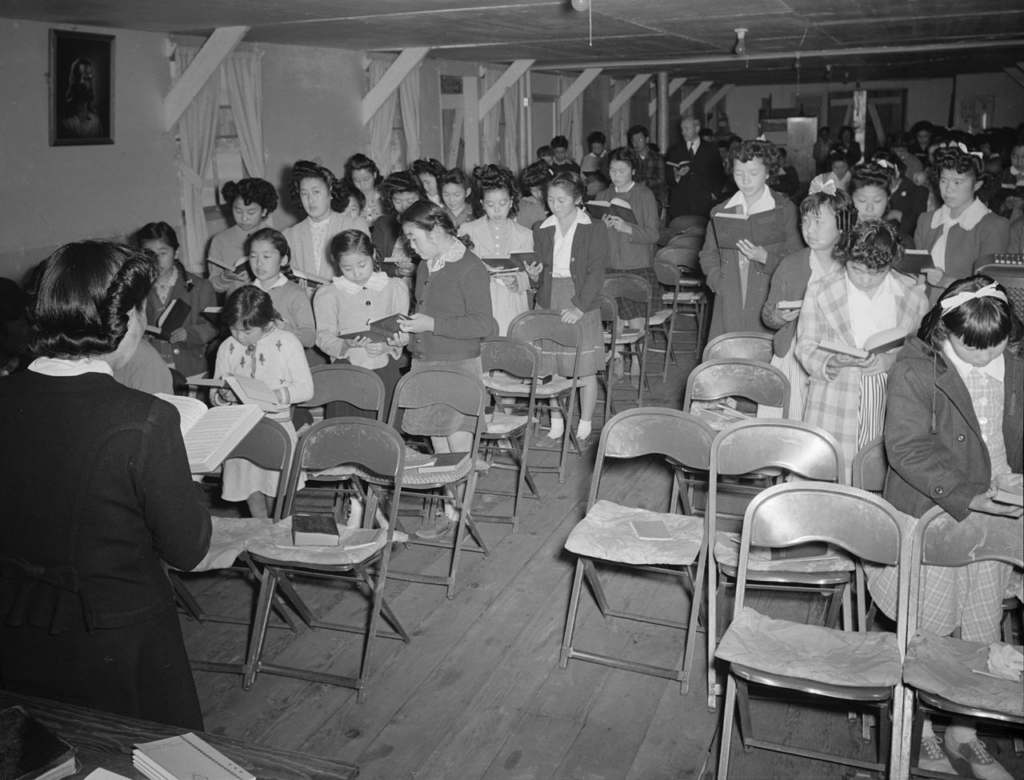
イギリスで全国民に公的初等教育が義務的に実施されるようになるのは、1880~90年になってからのことにゃ。日本とほぼ一緒にゃ。
それまで、貴族のおぼっちゃまは家庭教師をつけて勉強する一方で、労働者階級の半分くらいはこうした日曜学校に行って教会から教育を受けていたのにゃ。
そして今回も聖書回よ。「The smoke of her burning goeth* up for ever and ever」の部分ね。名前だけは聞いたことあるかな、「ヨハネの黙示録」が出典よ。
ヨハネの黙示録は「預言書」だからね。聖書が書かれたときから将来にわたって起こる災厄を予言したものとして捉えられているのよ。
Revelation 14:9-11(ESV)「ヨハネの黙示録」第14章9-11節
[9] And another angel, a third, followed them, saying with a loud voice, “If anyone worships the beast and its image and receives a mark on his forehead or on his hand, [10] he also will drink the wine of God’s wrath, poured full strength into the cup of his anger, and he will be tormented with fire and sulfur in the presence of the holy angels and in the presence of the Lamb. [11] And the smoke of their torment goes up forever and ever, and they have no rest, day or night, these worshipers of the beast and its image, and whoever receives the mark of its name.”
14:9 ほかの第三の御使が彼らに続いてきて、大声で言った、「おおよそ、獣とその像とを拝み、額や手に刻印を受ける者は、 14:10 神の怒りの杯に混ぜものなしに盛られた、神の激しい怒りのぶどう酒を飲み、聖なる御使たちと小羊との前で、火と硫黄とで苦しめられる。 14:11 その苦しみの煙は世々限りなく立ちのぼり、そして、獣とその像とを拝む者、また、だれでもその名の刻印を受けている者は、昼も夜も休みが得られない。 14:12 ここに、神の戒めを守り、イエスを信じる信仰を持ちつづける聖徒の忍耐がある」。
引用元:https://www.esv.org/Revelation+14/
http://bible.salterrae.net/kougo/html/revelation.html
ヨハネの黙示録で描かれているのは、罪を犯した人間を焼く炎の煙のシーンです。
いっぽうこちらでは、特に罪も犯してないのに、人間が神の炎(=火星人の攻撃)に焼かれて、ウェイブリッジに煙が立ち上っている、とカチューシャちゃんは言っているわけですね!
ちなみに、「教会を建て直した」とか「ウェイブリッジが…」という表現から、カチューシャはたぶん「Shepperton Church」のcurateだと推測されるぜ。第192話で、シェパートン教会の塔が建て直されているっていう表現が見えるからな。
解答編
<英文解釈記号ルール>
〔〕→関係詞句・節
【】→接続詞句・節
《》→挿入句・節
[ ] →名詞句・節
()→副詞句・節
〈〉→形容詞句・節
He gripped his knees* and turned (to look at me) again. (For half a minute), (perhaps), he stared silently.
“I was walking (through the roads) (to clear my brain),” he said. “And suddenly—fire, earthquake, death!”
He relapsed* into silence, (with his chin* now sunken* almost to his knees).
(Presently*) he began (waving his hand).
“All the work—all the Sunday schools—What have we done—what has Weybridge done? Everything gone—everything destroyed. The church! We rebuilt it only three years ago. Gone! Swept out of existence! Why?”
Another pause, and he broke out again like one demented*.
“The smoke of her burning goeth up for ever and ever!” he shouted.
His eyes flamed, and he pointed a lean* finger (in the direction of Weybridge).
1. オレンジのthe ChurchはShepperton Church。上の解説。
2. 赤のherが指しているものは、Weybridge。The Churchも可能性としてはありますけど、ソドムとゴモラに対応するならこちらも都市を指すと考えるのがいいでしょう。
※都市・国・船・車などは「she」が使えます。「姉妹都市」「姉妹艦」といった言葉を思い出しましょう。いちおう、教会もsheで受けないこともないみたいですが…。
全訳
助任司祭はひざを握りしめ、ふたたび頭を上げてわたしを見た。おそらく数十秒ほど、黙ってわたしを見つめていた。
「頭をすっきりさせようと思って道を散歩してたのだ」「そして突然ー火事、地震、殺戮だ!」
助任司祭はまた黙った。もう顔を半分膝にうずめていた。
すぐに、助任司祭は手を揺らし始めた。
「仕事は全部していたしー日曜学校もー私たちはいったい何をしたというのかーウェイブリッジにも罪なんてないではないか。みなやられてしまったーみな壊れてしまった。教会だってそうだ! つい3年前に建て直したばっかりなのに。跡形もなくやられてしまった!どうしてなのか?」
また口を閉じ、そして再び狂ったように話し始めた。
「ウェイブリッジに焦熱の煙が永遠に立ち上るのだ!」と叫んだ。
助任司祭の目は燃えているようだった。細い指でウェイブリッジの方をさしていた。
第13章 第11段落 (第226話)
問題編
By this time I was beginning to take his measure*. The tremendous tragedy in which he had been involved—it was evident he was a fugitive* from Weybridge—had driven him to the very verge of his reason.
“Are we far from Sunbury?” I said, in a matter-of-fact* tone.
“What are we to do?” he asked. “Are these creatures everywhere? Has the earth been given over to them?”
“Are we far from Sunbury?”
“Only this morning I officiated* at early celebration——”
“Things have changed,” I said, quietly. “You must keep your head*. There is still hope.”
“Hope!”
“Yes. Plentiful* hope—for all this destruction!”
take one’s measureどう対処すればいいかわかる fugitive避難民 matter-of-fact淡々とした officiate(宗教儀式を)主祭/司祭する keep one’s head落ち着く Plentiful豊富な
1. オレンジのitが指しているものは?
2. 赤のreasonの意味は?
3. 紫のfor allの意味は?
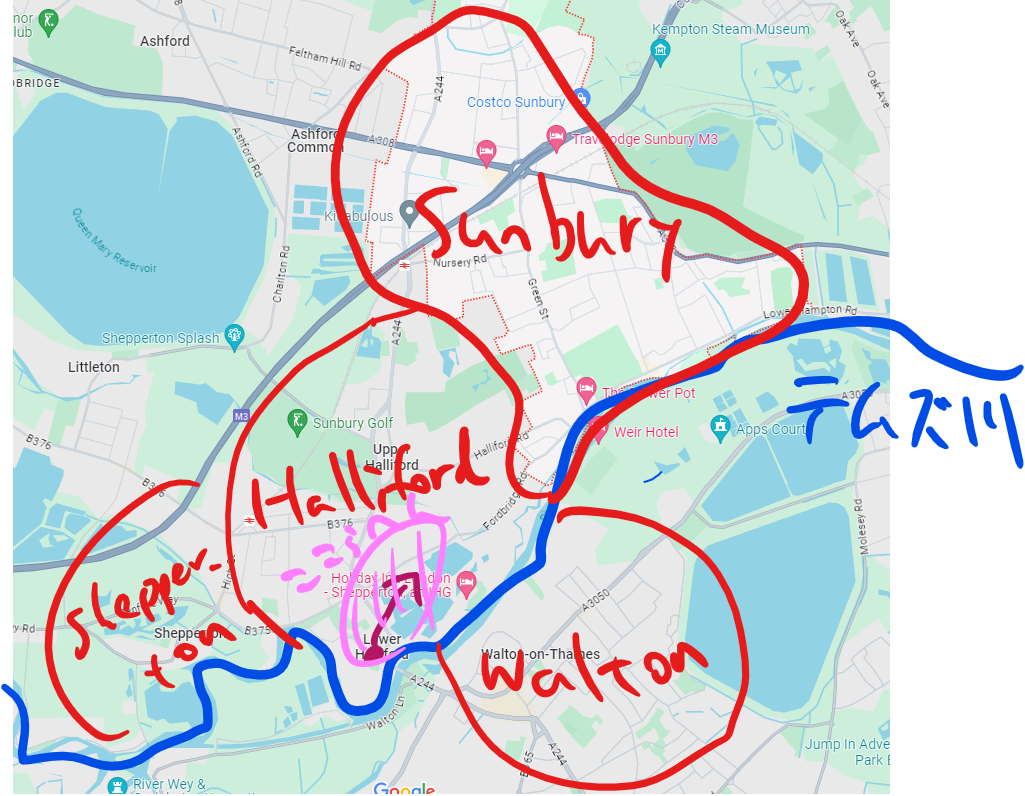
いちおう、地図です。
語り手たちはHallifordのあたりにいるわけです。
解答編
<英文解釈記号ルール>
〔〕→関係詞句・節
【】→接続詞句・節
《》→挿入句・節
[ ] →名詞句・節
()→副詞句・節
〈〉→形容詞句・節
(By this time) I was beginning to take his measure*. The tremendous tragedy 〔in which he had been involved〕《—it was evident he was a fugitive* from Weybridge—》had driven him (to the very verge of his reason).
“Are we far from Sunbury?” I said, in a matter-of-fact* tone.
“What are we to do?” he asked. “Are these creatures everywhere? Has the earth been given over to them?”
“Are we far from Sunbury?”
“(Only this morning) I officiated* at early celebration——”
“Things have changed,” I said, quietly. “You must keep your head*. There is still hope.”
“Hope!”
“Yes. Plentiful* hope—for all this destruction!”
1. オレンジのitが指しているものは、she was…Weybridge(省略されてるthat以下)。
2. 赤のreasonの意味は「理性」あたり。the verge of~で「~の瀬戸際」ですね。
3. 紫のfor allの意味は「~にもかかわらず」(≒despite≒with all)。
全訳
この段階になってようやく、わたしは助任司祭にどうしてあげればいいかわかってきた。とんでもない悲劇に巻き込まれて(助任司祭がウェイブリッジから避難してきたのは明らかだった)助任司祭は理性を失いかけていたのだ。
「ここはサンベリーから遠いか?」と、わたしは淡々とした口調で尋ねた。
「どうすればいいのだ?」と助任司祭は逆に聞いてきた。「あんな化けものがどこにでもいるっていうのか? この地球はやつらに支配されちゃうってのか?」
「ここはサンベリーから遠いか?」
「つい今朝は朝の礼拝をしてたのにーー」
「状況は変わったんだ」とわたしは静かに言った。「落ち着け。まだ希望はある。」
「希望?」
「うん。少なからず希望はあるーーこうした破滅の時においてもな。」
たのむ。話を聞いてくれ。
ひどい目に遭ったんだから、しばらく話させてくれてもいいじゃない。
これだからあんな風になるんだよ。
第13章 第12段落 (第227話)
問題編
I began to explain my view of our position. He listened at first, but as I went on the interest dawning* in his eyes gave place to their former stare, and his regard* wandered from me.
“This must be the beginning of the end,” he said, interrupting me. “The end! The great and terrible day of the Lord*! When men shall call upon the mountains and the rocks to fall upon them and hide them—hide them from the face of Him that sitteth upon the throne!”
I began to understand the position. I ceased* my laboured* reasoning, struggled* to my feet, and, standing over him, laid my hand on his shoulder.
“Be a man!” said I. “You are scared out of your wits*! What good is religion if it collapses under calamity*? Think of what earthquakes and floods, wars and volcanoes, have done before to men! Did you think God had exempted* Weybridge? He is not an insurance agent.”
dawn現れる regard視線 Lord主(神)ceaseやめる labouredこじつけの struggle to one’s feetなんとか立ち上がる(cf. rise to one’s feet) wit理知 calamity大惨禍 exempt免除する
1. 赤のasの節が閉じるのは?
2. 紫のtheir former stareはどんな状態?
3. 青アンダーラインでは、誰が何を求めている? ヒント:聖書
4. オレンジの out ofの意味は?
5. 赤アンダーラインはどういうこと?
青アンダーラインは助任司祭のセリフだし、まぎれもなく聖書だね!
引き続き「ヨハネの黙示録」が出典だよ!
その前にひとこと。聖書にはいくつかバージョンがあるんだが、過去4回の聖書回では、英語が読みやすい「ESV」(English Standard Version)(標準英語訳聖書)を引用してきた。
ただ今回は「KJV」(King James Version)(欽定訳聖書)を用いることにしてみようか。このバージョンは、イングランド国教会の公式聖書として19世紀末現在、イギリスでもっとも一般的なバージョンだ。
改訂は繰り返されてるけど、第一版が1611年に発行されているから、やや古い英語で書かれているぞ。
書いている内容自体はESVでもKJVでも変わんないんだけど、今回はわたしのセリフがKJVのパロディだから、KJVをつかってみるわ。
Revelation 6:12–17「ヨハネの黙示録」第6章12節~17節
[12] And I beheld when he had opened the sixth seal, and, lo, there was a great earthquake; and the sun became black as sackcloth of hair, and the moon became as blood; [13] And the stars of heaven fell unto the earth, even as a fig tree casteth her untimely figs, when she is shaken of a mighty wind. [14] And the heaven departed as a scroll when it is rolled together; and every mountain and island were moved out of their places. [15] And the kings of the earth, and the great men, and the rich men, and the chief captains, and the mighty men, and every bondman, and every free man, hid themselves in the dens and in the rocks of the mountains; [16] And said to the mountains and rocks, Fall on us, and hide us from the face of him that sitteth on the throne, and from the wrath of the Lamb: [17] For the great day of his wrath is come; and who shall be able to stand?[12] 小羊が第六の封印を解いた時、わたしが見ていると、大地震が起って、太陽は毛織の荒布のように黒くなり、月は全面、血のようになり、 [13] 天の星は、いちじくのまだ青い実が大風に揺られて振り落されるように、地に落ちた。 [14] 天は巻物が巻かれるように消えていき、すべての山と島とはその場所から移されてしまった。 [15] 地の王たち、高官、千卒長、富める者、勇者、奴隷、自由人らはみな、ほら穴や山の岩かげに、身をかくした。 [16] そして、山と岩とにむかって言った、「さあ、われわれをおおって、御座にいますかたの御顔と小羊の怒りとから、かくまってくれ。 [17] 御怒りの大いなる日が、すでにきたのだ。だれが、その前に立つことができようか」。
引用元:https://www.kingjamesbibleonline.org/Revelation-Chapter-6/
http://bible.salterrae.net/kougo/html/revelation.html
ということで、青アンダーライン「When men shall call upon the mountains and the rocks to fall upon them and hide them—hide them from the face of Him that sitteth upon the throne!」の意味もわかるわよね。
「なんでもいいから、神の怒りから守ってちょうだいよ!」ってこと。
あれ、「神様、たのみますから守ってください!」じゃないんですか?
じゃないわ。ここは、愚かな人間に神が罰を与えるシーンよ。
ちなみに、これは子羊(に扮した神)が「Seven Seals」(7つの封印)を解除するエピソードの一部にゃ。封印を解除するにしたがって様々なイベントが起こるんだけど、それが終末の出来事の預言をしているともいわれてるにゃ。
すべての封印が解除されたとき、全部で7人の天使がラッパを吹いて災害をもたらすのにゃ。
おいちょっとまて。それ、完全にドルマゲドン(デュエマ)じゃないか!
場に出す前は封印が4つ付けられてて、封印が取れるにつれて効果が発動する。そして全部封印が外れたときには999マナ・999999パワーという最強クリーチャーとなって現れるんだったよな。初めてこんなビッグサイズのクリーチャーがでてきたときは興奮したものだぜ!
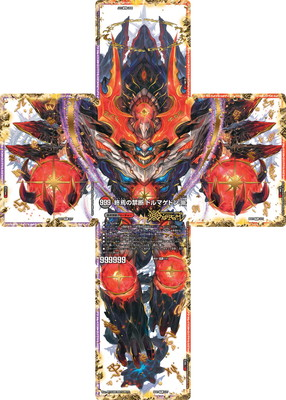
(世代がバレるにゃ)
そうにゃ。ドルマゲドンは間違いなくここら辺の記述をもとにしてるにゃ。
ま、ともあれ、上記引用は6つめの封印だから、それに対応する6人目の天使がもたらす災害について見ていくにゃ。2か所あるにゃ。(「Seven Trumpets」と「Seven Bowls」の話)
まず1か所目はこちらです!
ぶっちゃけ日本語訳だけ読めばいいですよ!
Revelation 9:13–18 「ヨハネの黙示録」第9章13節~18節
[13] And the sixth angel sounded, and I heard a voice from the four horns of the golden altar which is before God, [14] Saying to the sixth angel which had the trumpet, Loose the four angels which are bound in the great river Euphrates. [15] And the four angels were loosed, which were prepared for an hour, and a day, and a month, and a year, for to slay the third part of men. [16] And the number of the army of the horsemen were two hundred thousand thousand: and I heard the number of them. [17] And thus I saw the horses in the vision, and them that sat on them, having breastplates of fire, and of jacinth, and brimstone: and the heads of the horses were as the heads of lions; and out of their mouths issued fire and smoke and brimstone. [18] By these three was the third part of men killed, by the fire, and by the smoke, and by the brimstone, which issued out of their mouths.
9:13 第六の御使が、ラッパを吹き鳴らした。すると、一つの声が、神のみまえにある金の祭壇の四つの角から出て、 9:14ラッパを持っている第六の御使にこう呼びかけるのを、わたしは聞いた。「大ユウフラテ川のほとりにつながれている四人の御使を、解いてやれ」。 9:15すると、その時、その日、その月、その年に備えておかれた四人の御使が、人間の三分の一を殺すために、解き放たれた。 9:16 騎兵隊の数は二億であった。わたしはその数を聞いた。 9:17そして、まぼろしの中で、それらの馬とそれに乗っている者たちとを見ると、乗っている者たちは、火の色と青玉色と硫黄の色の胸当をつけていた。そして、それらの馬の頭はししの頭のようであって、その口から火と煙と硫黄とが、出ていた。 9:18この三つの災害、すなわち、彼らの口から出て来る火と煙と硫黄とによって、人間の三分の一は殺されてしまった。
引用元:https://www.kingjamesbibleonline.org/Revelation-Chapter-9/
http://bible.salterrae.net/kougo/html/revelation.html
6番目のラッパは、神の軍勢が悪しき人類を殺戮するために吹かれるにゃ。
「人間の三分の一を殺す」は、『宇宙戦争』では火星人が人類を殺すことと対応しているにゃ。
「口から火と煙と硫黄とが、出ていた」は、『宇宙戦争』ではロボットがレーザー光線を放っていることと対応してるにゃ。
つづいて2か所目はこちらです!
Revelation 9:13–18 「ヨハネの黙示録」第9章13節~18節
[12] And the sixth angel poured out his vial upon the great river Euphrates; and the water thereof was dried up, that the way of the kings of the east might be prepared. [13] And I saw three unclean spirits like frogs come out of the mouth of the dragon, and out of the mouth of the beast, and out of the mouth of the false prophet. [14] For they are the spirits of devils, working miracles, which go forth unto the kings of the earth and of the whole world, to gather them to the battle of that great day of God Almighty. [15] Behold, I come as a thief. Blessed is he that watcheth, and keepeth his garments, lest he walk naked, and they see his shame. [16] And he gathered them together into a place called in the Hebrew tongue Armageddon.
16:12 第六の者が、その鉢を大ユウフラテ川に傾けた。すると、その水は、日の出る方から来る王たちに対し道を備えるために、かれてしまった。 16:13 また見ると、龍の口から、獣の口から、にせ預言者の口から、かえるのような三つの汚れた霊が出てきた。 16:14 これらは、しるしを行う悪霊の霊であって、全世界の王たちのところに行き、彼らを召集したが、それは、全能なる神の大いなる日に、戦いをするためであった。 16:15(見よ、わたしは盗人のように来る。裸のままで歩かないように、また、裸の恥を見られないように、目をさまし着物を身に着けている者は、さいわいである。) 16:16 三つの霊は、ヘブル語でハルマゲドンという所に、王たちを召集した。
引用元:https://www.kingjamesbibleonline.org/Revelation-Chapter-16/
http://bible.salterrae.net/kougo/html/revelation.html
6番目の天使が鉢を傾けることによって、ユーフラテス川が干上がって、地上の王VS神の最終戦争の戦場「ハルマゲドン」(ドルマゲドンの元ネタ)となるにゃ。
『宇宙戦争』においては、ユーフラテス川↔テムズ川、地上の王↔イギリス、神↔火星人という対応関係があるのは言うまでもないにゃ。テムズ川沿いでイギリス軍と火星人の戦闘が行われることが示されてるにゃ。
H・G・Wellsさんがそこまで意識していたかはわからんが、キリスト圏のひとたちの深層意識に聖書が刻まれていることはしっかり認識するべきだろうな。
ちなみに、16:15に「目をさまし着物を身に着けている者は、さいわいである。」とあるが、わたしがいま服を着てないことも何か関係があるのだろうか…。
解答編
<英文解釈記号ルール>
〔〕→関係詞句・節
【】→接続詞句・節
《》→挿入句・節
[ ] →名詞句・節
()→副詞句・節
〈〉→形容詞句・節
I began to explain my view of our position. He listened (at first), but 【as I went on】 the interest 〈dawning* in his eyes〉 gave place to their former stare, and his regard* wandered from me.
“This must be the beginning of the end,” he said, (interrupting me). “The end! The great and terrible day of the Lord*! When men shall call (upon the mountains and the rocks) (to fall upon them and hide them)—hide them from the face of Him 〔that sitteth upon the throne〕!”
I began to understand the position. I ceased* my laboured* reasoning, struggled* to my feet, and, standing over him, laid my hand on his shoulder.
“Be a man!” said I. “You are scared (out of your wits)*! What good is religion 【if it collapses under calamity*】? Think of [what earthquakes and floods, wars and volcanoes, have done (before) (to men)]! Did you think God had exempted* Weybridge? He is not an insurance agent.”
1. 赤のasの節が閉じるのはonです。
2. 紫のtheir former stareは、さっきまでの状態ですから、目が虚ろで遠くを見ているような感じです。
3. 青アンダーラインについては上の解説通り。アンドリューシャちゃんが、神の怒りから逃れられるように祈っているってとこですね。
4. オレンジの out ofの意味は「~がなくなって」。
5. 赤アンダーラインは、「神は保険会社(のエージェント)じゃないよ」。保険会社は災害が起こると保険金を払わないといけませんから災害が起きてほしくありません。でも神はそんなこと気にしない、つまり、「神は災害を躊躇なく起こす」ということですね。
全訳
わたしは今いる場所がどこか自分の見解を説明し始めた。助任司祭は最初聞いてくれていたが、わたしが話し続けるにつれて、目にあらわれていた興味はなくなり、視線は虚空を彷徨うようになった。
「終わりの始まりに違いない」とわたしの話をさえぎって助任司祭が言った。「終末よ!神がもたらす偉大で畏ろしい日だ! いまこそ山と岩とにむかって、『われわれを覆って、御座にまします主の御顔からかくまってくれ』って叫ぶときじゃないか!」
わたしは現在地を理解し始めた。こじつけな推理をやめ、なんとか立ち上がり、見下ろしながら、彼の肩の上に手を置いた。
「しっかりしろよ!」「理性がなくなってひたすら怖がってるじゃないか!大惨事を前にして宗教が崩壊してしまったら、宗教は何の役に立つんだ? 地震、洪水、戦争、火山がいままで人間にもたらしたものを考えてみろ! 神がウェイブリッジだけ特別扱いするとでも思ったのか? 保険会社の代理人じゃないんだぞ」
第13章 第13段落 (第228話)
問題編
For a time he sat in blank* silence.
“But how can we escape?” he asked, suddenly. “They are invulnerable*, they are pitiless*.”
“Neither the one nor, perhaps, the other,” I answered. “And the (mightier*, are, sane* and wary*, they, the, should, more) we be. One of them was killed yonder* not three hours ago.”
“Killed!” he said, staring about him. “How can God’s ministers* be killed?”
“I saw it happen.” I proceeded to tell him. “We have chanced to come in for the thick of* it,” said I, “and that is all.”
“What is that flicker* in the sky?” he asked abruptly.
I told him it was the heliograph* signalling—that it was the sign of human help and effort in the sky.
blank空虚な invulnerable(<in+vlunerable)びくともしない pitiless(<pity+less)容赦ない mighty強力な sane正気の wary用心する yonderむこうで minister代理人 for the thick of~の最も激しい場面で flicker明滅 heliographヘリオグラフ(光を用いた通信機:第181話)
1. 赤アンダーラインを、the oneとthe otherが指しているのが何かわかるように訳すと?
2. 青アンダーラインの語句を並び替えると?
カチューシャ(助任司祭)のセリフ「How can God’s ministers be killed」から、やっぱり前段落で取り扱ったヨハネの黙示録を踏まえていることがわかるな。第六御使が召喚した神の軍勢が、地上の人々を殺していったのだった。
エヴァ新劇の第六使徒(正八面体のラミエル)だいすき。きゅいーんきゅいーん。
(※「使徒」はキリストの教えを広める弟子たちを指す言葉だから、ヨハネの黙示録で災厄を与えた天使を「使徒」って言っちゃだめだからね)

新劇の対第六使徒戦で一番感動したのは、後方支援部隊の活躍のシーンだったなぁ。
あの戦闘はロジスティックス(物流・兵站)担当部の貢献が9割だよな、ほんとに。
解答編
<英文解釈記号ルール>
〔〕→関係詞句・節
【】→接続詞句・節
《》→挿入句・節
[ ] →名詞句・節
()→副詞句・節
〈〉→形容詞句・節
(For a time) he sat (in blank* silence).
“But how can we escape?” he asked, suddenly. “They are invulnerable*, they are pitiless*.”
“Neither the one nor, 《perhaps》, the other,” I answered. “And the mightier they are the more sane and wary should we be. One of them was killed yonder* (not three hours ago).”
“Killed!” he said, (staring about him). “How can God’s ministers* be killed?”
“I saw it happen.” I proceeded to tell him. “We have chanced to come in (for the thick of* it),” said I, “and that is all.”
“What is that flicker* (in the sky)?” he asked abruptly.
I told him [it was the heliograph* signalling]—[that it was the sign of human help and effort in the sky].
1. 赤アンダーラインのthe oneは、火星人が無敵だということ。the otherは火星人が情け容赦ないということですかね。
2. 青アンダーラインの語句を並び替えると上の通り。the比較級+the比較級の構文ですが、比較級のあとのSVは倒置されることがありますので気をつけましょう。
全訳
しばらく、リューちゃんはぼんやりと黙っていた。
「でもどーやって逃げるってのよ?」と突然聞いて来た。「あいつら無敵だし、一切容赦ないわよ」
「いや、少なくとも無敵ではないし、もしかしたら少しくらい容赦してくれるかもしれない」とわたしは答えた。「火星軍が強いんだったら、その分わたしたちも正気を保って、慎重にいけばいいはずだ。ロボットの内の一体は向こうでつい3時間前に倒されたんだ。」
「やったの!?」とあたりを見回しながらリューちゃんは言った。「神の使者をどうして殺せるのよ?」
「でも実際見たんだって」とわたしは続けた。「たまたま激戦のさなかに巻き込まれたんだ。それだけだよ」
不意に、「あそこで光ってるものはなに?」と聞いてきた。
「あれはヘリオグラフが信号を送ってるんだ。あの空のきらめきは、人類を護らんと努力している証なのだ」とリューちゃんに語った。
第13章 第14段落 (第229話)
問題編
“We are in the midst* of it,” I said, “quiet as it is*. That flicker* in the sky tells of the gathering storm*. Yonder*, I take it are the Martians, and Londonward*, where those hills rise about Richmond and Kingston and the trees give cover, earthworks* are being thrown up* and guns are being placed. Presently* the Martians will be coming this way again.”
And even as I spoke he sprang to his feet* and stopped me by a gesture.
“Listen!” he said.
From beyond the low hills across the water came the dull* resonance* of distant guns and a remote weird crying. Then everything was still. A cockchafer* came droning* over the hedge* and past us. High in the west the crescent moon* hung faint and pale above the smoke of Weybridge and Shepperton and the hot, still splendour* of the sunset.
“We had better follow this path,” I said, “northward.”
midst真っただ中 as it is現状では flicker明滅 gathering storm嵐の到来(比喩的表現) yonder遠くで Londonwardロンドンの方で earthwork土塁 throw up急造する presentlyすぐに spring to one’s feet急に立ち上がる dull鈍い resonance反響 droneブンブンうなる hedge生垣 crescent moon三日月 splendour壮麗さ
1. 青アンダーラインの語順倒置を元に戻すと? 【ヒント:take it that SV:きっとSVだと思う】
2. 赤のandが繋いでいるものは?
3. オレンジのandが繋いでいるものは?
4. 緑のandが繋いでいるものは?
「cockchafer」はヨーロッパコフキコガネという虫ね。
そんな気持ち悪くないから、写真も載せておくわよ。
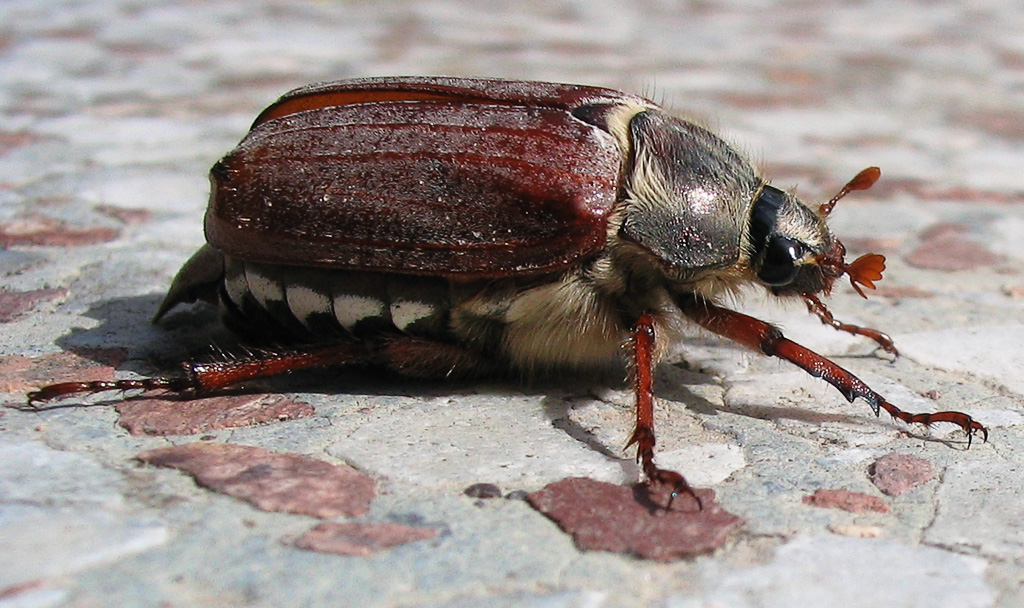
https://commons.wikimedia.org/w/index.php?curid=134485
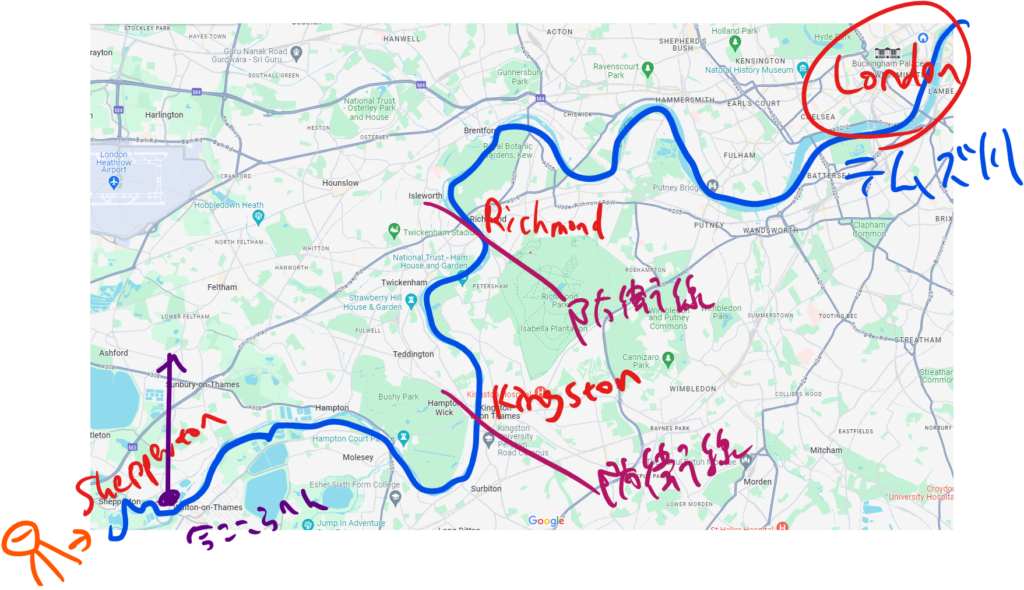
Mapだよ!
ロンドン方面に進撃する火星軍と、テムズ川沿いに防衛線を築くイギリス軍の間に二人はいるわけだね!巻き込まれないようにするために、北の方へ逃げて行こうとしてるってことかな。
解答編
<英文解釈記号ルール>
〔〕→関係詞句・節
【】→接続詞句・節
《》→挿入句・節
[ ] →名詞句・節
()→副詞句・節
〈〉→形容詞句・節
“We are (in the midst* of it),” I said, “quiet as it is*. That flicker* in the sky tells of the gathering storm*. Yonder*, 《I take it》 are the Martians, and (Londonward*), 【where those hills rise (about Richmond and Kingston) and the trees give cover】, earthworks* are being thrown up* and guns are being placed. (Presently*) the Martians will be coming (this way) (again).”
And 【even as I spoke】 he sprang to his feet* and stopped me (by a gesture).
“Listen!” he said.
(From beyond the low hills across the water) came the dull* resonance* of distant guns and a remote weird crying. Then everything was still. A cockchafer* came droning* (over the hedge*) and (past us). (High in the west) the crescent moon* hung faint and pale (above the smoke of Weybridge and Shepperton and the hot, still splendour* of the sunset).
“We had better follow this path,” I said, “northward.”
1. 青アンダーラインの語順倒置を元に戻すと?「I take it that yonder are the Martians. (the Martians are yonder)」あたりでしょうか(take it that SV:きっとSVだと思う)。I take itが挿入されてて、Yonder are the MartiansのMVS第一文型倒置となっているという解釈でいいと思います。
2. 赤のandが繋いでいるものは、前後のSV。Yonder~とLondonward~で、ウェイブリッジ方面とロンドン方面を並べているわけですね。
3. オレンジのandが繋いでいるものは、where節内の2つのSV。
4. 緑のandが繋いでいるものは、above句内の、the smoke…とthe hot, still splendour…。
全訳
わたしは言った、「われわれは戦争の真っただ中にいる。いまは静かだけど、あの空に明滅しているのは風雲急を告げる光だ。あちらには火星人がいるのだろう。そしてロンドン方面においては、リッチモンドとキングストン周辺の坂で、森を遮蔽物として防衛線が急築され、大砲が配置についているんだ。すぐにまたこの道を火星人がやってくるだろうな。」
わたしが話しているときででさえ、助任司祭は飛び跳ねたり、身振り手振りで話を止めてほしそうにしていた。
ついに「聞いてよ!」と助任司祭が言った。
対岸の緩やかな坂を越えた遠くの方から、大砲を撃つ鈍い反響音や、奇妙な叫び声が聞こえてきた。そしてことごとく静かになった。コフキコガネがブンブンいいながら生垣を越えて通り過ぎていった。西の空高くには三日月が浮かんでおり、ウェイブリッジとシェパートンからの煙や、暑くじっと動かない壮麗な夕日のせいで、おぼろげで青白く見えた。
「この道を行くのがいいだろう」とわたしは言った。「北へ。」
ということで、ミカと離れ離れになったと思ったら、今度はカチューシャと一緒に行動することになった第13章だった。これからしばらくの間、北(北東)へ歩くことになるぞ。
さて次の第14章はわたしの弟が登場する。ロンドンでの物語だ。


コメント